
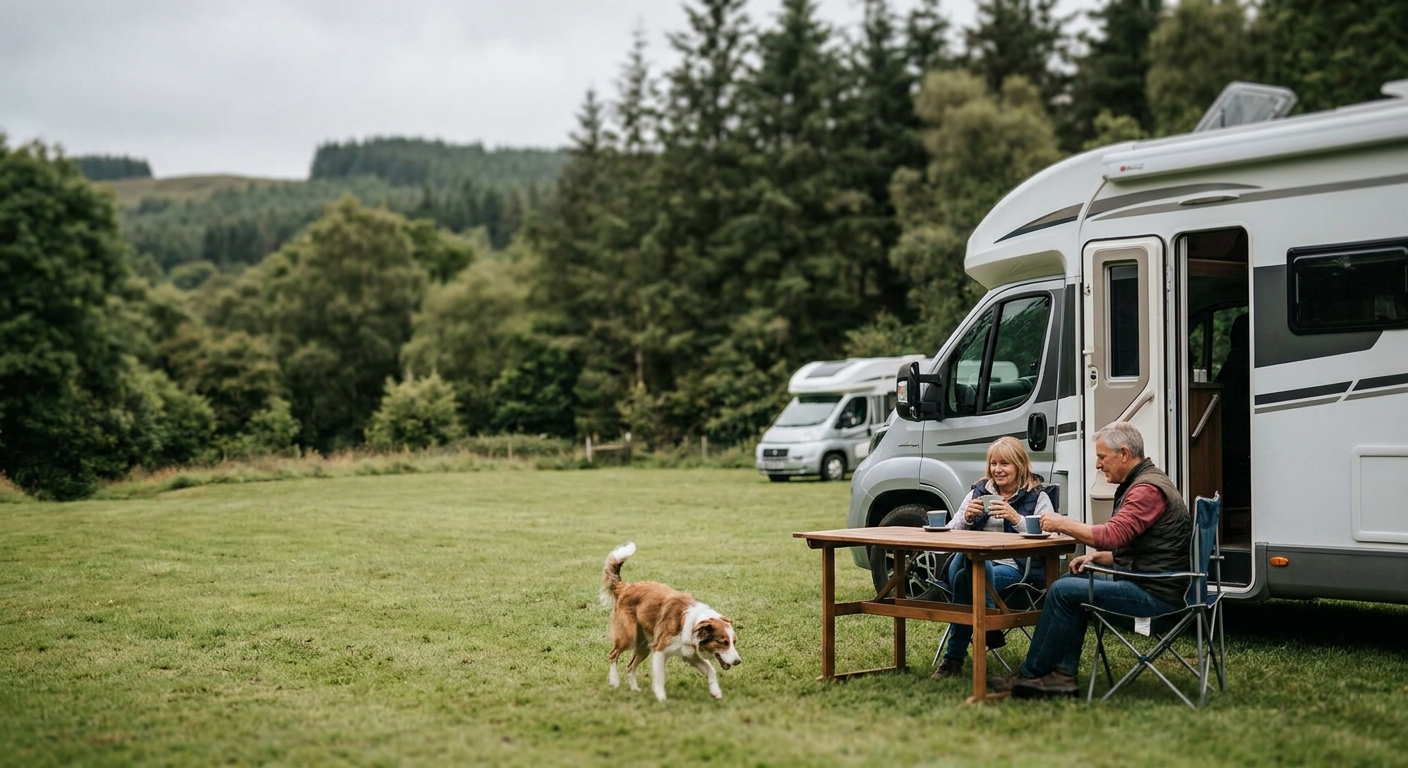
This image was generated with the help of AI.
Motorhome Pitches in the Vienna Woods: Why 90 m² Is Worth More Than Any Star Rating
Why this motorhome site in the Vienna Woods is more than a car park
You turn off and roll the last 400 metres into the side valley. Engine off. Meadow, mixed woodland, a mountain stream, a few sheep in the neighbouring field. No appointment calling.
My view after more than forty years of camping on our own farm: a motorhome site in the Vienna Woods is not made good by the number of pitches. It is made good by what lies between them. Distance, a hedge, an old fruit tree. Room for the awning without looking into your neighbour’s breakfast.
So here are a few figures instead of advertising language:
- Address: Höfnergraben 2, 2572 Kaumberg, Lower Austria, a quiet side valley in the southern Vienna Woods
- Distance to Vienna: around 30 to 35 kilometres, city and quiet on the same day
- Around 50 tourist pitches, plus long stay camping
- 90 to over 100 m² per pitch, mostly level, with individual trees and hedges
- Every pitch with electricity, drinking water and waste water disposal through our own sewer system
What you will not find here: a gravel chessboard behind a supermarket. No taking a number, no white line 30 centimetres from your mirror, no generator noise until midnight.
The site is long and narrow. All around are meadows and wooded hills. Open the window at night and you hear the stream. Why this quiet retreat in the Vienna Woods feels different from a site on an arterial road is something you notice on the first night.
In this article I go through, in order, what motorhome travellers want to know before setting off. First the infrastructure and the sanitary building. Then the way to Vienna, including without a car, and the route towards Hungary that saves around 30 kilometres. After that the nature and the sheep farm around us. Finally prices, payment and reservation.
What I mean by full infrastructure: electricity, drinking water and waste water at every pitch
Infrastructure is not a matter of taste. It works or it does not. Either you connect the hose and have drinking water, or you carry canisters across the meadow. Either your waste water drains away, or you queue at the disposal station in the morning.
That is why every single pitch here has the three connections a motorhome needs:
- Electricity at the pitch, charged by meter reading at EUR 0.50 per kW
- Drinking water at the pitch, not a shared tap somewhere behind the sanitary building
- Waste water disposal through the site’s own sewer system, right at the pitch
Water and sewer use are included in the overnight price. With electricity I consider a flat rate unfair. Someone travelling with solar who leaves a lamp on in the evening should not pay the same as someone running air conditioning for three days. Meter reading in, meter reading out, done.
We have had wifi since 2014, 1 GB fair use free of charge. That is enough for the weather forecast, route planning and messages home. Anyone wanting to stream series will not be happy with it. I would rather say that beforehand than afterwards.
This is not a glossy resort with a wellness temple and an entertainment team. It is a sheep farm in a side valley. Along with around 50 generous pitches, a sanitary building put up in 2005 and connections that do what they promise. If this is your first trip in a motorhome, our vanlife tips for beginners in Austria cover what we explain to first time campers on site anyway.
And one more point I will say openly: with us payment is cash only. No card, no app. At least you know it now, and not once you have already unhitched.
Sanitary facilities: the point where sites are decided
I know the verdict from many conversations on site. After the first shower you know where you stand. Not at reception, not in the brochure, but in the shower room.
And I think that is a pretty good verdict. Anyone driving a motorhome has their own bathroom. Leaving it unused and walking to the sanitary building only happens when it is better there than in the vehicle.
Our sanitary building was newly built in 2005. Modern showers, separate toilet rooms, accessible for people with disabilities. ADAC rated the building five stars, and the Dutch ANWB gives 8.3. In 2007 we received the EU Ecolabel for the first time, the European Union’s highest environmental award. According to the province of Lower Austria, Kaumberg is one of the locations of the ten best campsites in the province.
My own attitude is less euphoric than the list suggests. Awards do not replace daily work. A plaque on the wall cleans no shower floor and descales no tap. What they do show is something else: someone from outside has looked closely, repeatedly, over years. Anyone who tidies up only once does not get one of those twice.
The second thing counts for more with me than any rating: being reachable. When the power post plays up or the water does not come, you do not want to go looking for someone. Here it is arranged like this:
- Leopold Grandl, the owner, personally reachable on +43 676 4741966
- For technical questions on site and for anything else that comes up
- Reservations by email: reservierung@camping-noe.at
No call centre, no transfer. A person who knows the site because he lives on it. That is the answer to the question of why a shower room stays clean.
Camping in the Vienna Woods as a base camp: Vienna by day, quiet in the evening
The rhythm sets in by itself after two days. In the morning you set off, by bus or by car, and after around 30 kilometres you are in the middle of the city. Schönbrunn Palace, the Hofburg, the Imperial Crypt, a museum on the Ring, an opera or the Prater in the evening.
If you prefer it gentler: a wine tavern in Grinzing or a horse drawn carriage ride through the old town. Afterwards you drive back into a side valley near Kaumberg. There it really does go quiet in the evening.
That contrast is exactly the point. A motorhome site in the Vienna Woods gives you both. A city centre site usually gives you only the first. What a day like that looks like in practice, I have written up in the article on the base camp for Vienna and nature.
- No hunting for parking with seven metres of vehicle. You put the motorhome on the pitch once and leave it there. Bus line 169 runs from Kaumberg straight to Matzleinsdorfer Platz, a journey of around 55 minutes. From there you continue by underground, suburban railway or tram. Timetables and prices are on vor.at or in ÖBB Scotty. There are only two to three departures a day, so plan your day around them.
- No traffic noise at six in the morning. Instead of traffic on an arterial road, you hear the stream and the sheep from the farm next door.
- Space instead of pitch Tetris. The pitches are around 90 to over 100 square metres, with electricity, drinking water and waste water disposal right there. Awning out, chair down, done.
- Meadow and forest at the door. After a city day with 12,000 steps on asphalt, a walk between fruit trees does more than another coffee.
Fill up on city, refill on nature. Anyone who has ever spent the night beside a four lane road in Vienna knows why the half hour drive is well invested.
A motorhome site near Vienna: visiting the city without motorhome stress
Anyone who has steered seven metres of vehicle through the first district knows you do that exactly once. Narrow lanes, height restrictions in car parks, short stay zones. The finest day in Vienna collapses before it has begun.
That is why our site works so well as a base. The motorhome stays connected to electricity, water and sewer. You take the bus.
VOR bus line 169 takes you straight to Matzleinsdorfer Platz in Vienna. You board at the stops Kaumberg/Höfnergraben, Kaumberg/Marktplatz or Kaumberg/Renzenhof. The journey takes around 55 minutes, and a ticket costs roughly 7 to 11 euro depending on the fare. At Matzleinsdorfer Platz you change to the underground, suburban railway or tram and are at the opera, the Hofburg or Schönbrunn within minutes.
An honest note: there are only around two to three departures per day. The times differ depending on the day of the week. So plan the way back before you set off. Current timetables are on vor.at, postbus.at or in ÖBB Scotty.
We deliberately do not quote departure times that could be different tomorrow. And for the drive here, with no guesswork:
- From the west (A1): exit St. Pölten Süd, B20 to Traisen, at the roundabout onto the B18 towards Hainfeld and on to Kaumberg.
- From Vienna (A21): exit Mayerling, via the B11 towards Hafnerberg onto the B18 to Altenmarkt, through the village, 1 km after Thenneberg turn left, then another 400 metres.
- From the south (A2): exit Leobersdorf, via Berndorf onto the B18, 1 km after Thenneberg turn left.
All well built roads, no hairpin surprises. If you are using satnav: Höfnergraben 2, 2572 Kaumberg.
A stop on the way to Hungary: why the route via Kaumberg is shorter
Anyone driving from Germany or the Netherlands towards Lake Balaton or Budapest knows the ritual. South of Vienna it gets dark, your eyes get heavy. In the end the motorhome stands between lorries at a service area: engine noise for half the night, a cold tap in the morning, no waste water connection. It does not have to be that way.
Our site in Kaumberg lies directly on the shortest route for travellers heading to Hungary. Compared with the standard route you save around 30 kilometres. The way is simple:
- From the site onto the B18 towards Günselsdorf
- From Günselsdorf onwards towards Eisenstadt
- From there straight on into Hungary
So instead of an emergency overnight stop you make a proper break. What is taken care of before you drive on:
- Waste water emptied through the site’s own sewer system, right at the pitch
- Fresh water topped up, there is a drinking water connection at every pitch
- A hot shower in the sanitary building, rated five stars by ADAC
- Electricity by meter reading, batteries full for the onward journey
- A quiet night’s sleep in a side valley, without the motorway hum
Advice from experience: plan one more night. Anyone who comes just to sleep and rolls on again at eight has dealt with the technical side but seen nothing of the Vienna Woods. Then the detour feels like driving through. That is a shame.
Two nights is a different kind of travelling. You have a whole day on which you have to do nothing. Walk up to the Araburg, the highest castle ruin in Lower Austria. Or eat home cooking at the inn on site and watch the sheep in the neighbouring field.
It works the same way on the return trip. Many guests who have stopped here once plan the stop in both directions the next time.
Hiking, cycling, the Via Sacra: what you can reach on foot and by bike
You do not have to get in the car to get going. Kaumberg has 52 km of marked hiking trails. From here they start practically at the door. Sometimes an hour through mixed woodland, sometimes half a day across meadows and hills. Which routes start right at the site is covered in the article on the campsite with hiking trails in the Vienna Woods.
The best known destination is the Araburg castle ruin at 800 m above sea level, the highest castle ruin in Lower Austria. From the centre of Kaumberg you follow the green markings. Around 1.5 hours on foot across meadows and through woodland. At the top it is worth standing still for a while. If you want a second tour, the Peilstein is the other destination everyone here knows.
By bike things open up. The Triesting and Gölsen valley cycle route runs 62 km from Hirtenberg or Leobersdorf to St. Pölten, along the riverbanks, through small villages, past country inns. It connects the thermal region route with the Traisen valley route, and from there you have a link to the Danube cycle path. For a few days of cycling from a fixed base that is a good starting position: out during the day, back to your own pitch in the evening.
Then there is the Via Sacra, Austria’s oldest pilgrim route to Mariazell, running right past the site. For pilgrims that means in practice:
- Showering in the sanitary building, charging your phone, using the free wifi
- Leaving the car on site by arrangement until you return
- Arriving on the Mariazell bus VOR 552 from Wien Mitte directly to Kaumberg
- Returning from Mariazell by bus or on the Mariazellerbahn via St. Pölten
Timetables change. Please check current times on vor.at or in ÖBB Scotty. If you are planning a stage and are unsure about the timing, give us a quick call. Leopold Grandl knows the routes here.
Excursions for rainy days and culture lovers
It rains for three days in a row. That happens in the Vienna Woods. Then the motorhome stays put and you head off by car. The region has enough for several grey days.
- Melk Abbey: baroque grandeur above the Danube, a good hour’s drive.
- The pilgrimage church of Klein-Mariazell: just around the corner, quiet, without coach parties.
- Heiligenkreuz Abbey and Mayerling: a Cistercian monastery and the place where Habsburg history took one of its darkest turns.
- Laxenburg Palace: the park and the Franzensburg, worth a long walk even in drizzle.
To the east the thermal region begins. Historic thermal baths, and between them wine villages that have lived off the slopes for generations. A wine tavern in Gumpoldskirchen is the uncomplicated option: a mixed set wine, a cold platter, and the afternoon is gone. In the spa town of Baden there are operettas at the theatre in summer, and the casino.
When the clouds break up again, the mountains to the south are worth it. The Schneeberg (2,076 m) with its historic rack railway, the Rax (2,007 m) with its cable car. From the top, on a clear day, the view stretches to the Hungarian plains in the east and the main Alpine ridge in the west. Two hours up, a summit lodge, done.
If you have the grandchildren with you, the White Zoo with its camel theatre in Kernhof is the safe bet. Austria’s only white tigers live there, along with snow leopards, albino kangaroos and camels. The Himalaya show and the Sepp Forcher viewing tower are part of it too.
One tip that will save you trouble: please check opening times, admission prices and show dates on the official websites in advance. In the low season in particular, operations change at short notice, especially with the railways and cable cars. Leopold knows the region and will gladly tell you what is worth doing on your day.
Sheep farm, 120 old fruit varieties and Natura 2000: this place has a history
Many sites came into being at some point on an empty field, because there was money in it. Here it was the other way round. First there was the farm, then came the campsite.
The farmstead is first mentioned in the house chronicle in 1380 and has been in family ownership for around 200 years. In 1980 a small campsite was added. In June 2006 the current layout with around 50 pitches was finished. That is not a marketing detail. It explains why the pitches are large and the meadows have stayed meadows.
The farm is still working. The sheep graze not far from the pitches, and you hear them before you have to look for them. Owner Leopold Grandl is also a dedicated fruit farmer and tends around 120 old fruit varieties on the grounds. He grafted and planted about 70 of them himself. Ask him about it when you meet him.
The surroundings are no coincidence either. All around are Natura 2000 protected areas with calcareous dry grassland and beech forests. Protected species include the marsh fritillary butterfly and the lesser mouse eared bat. The Vienna Woods to the north of the site are a biosphere reserve and a Natura 2000 area.
The guiding principle here is “living in nature with nature”. You can tell from the way the land is divided up that this is not an empty phrase. What that contrast with the city feels like is described in the article 30 km from Vienna, another world.
In practical terms that means for you:
- An inn on site with drinks and home cooking from its own kitchen. If you are counting on it, ask the owner about availability in advance.
- Dogs are welcome. Meadow, forest and farm tracks right at the door instead of a lap of asphalt.
- A site that has developed over decades, with old trees and hedges between the pitches.
Prices, season and reservation: what to know before you enquire
Let us talk numbers before you start the engine. The 2026 season runs from 30 March to 30 September 2026. You can send enquiries all year round, ideally by email to reservierung@camping-noe.at. A tip from experience: if there is no confirmation after a few days, take a look in your spam folder.
If you would rather talk than type, you can reach Leopold Grandl on +43 676 4741966. That is precisely the difference from many sites where nobody answers the phone. Here the owner picks up himself.
The prices per night, so you can work it out:
- Caravan or motorhome with 2 people: EUR 33.00
- Caravan or motorhome with 1 person: EUR 19.00
- Tent with 2 people: EUR 28.00
- Each additional person: EUR 14.00
- Children aged 5 to 13: EUR 6.00 per day
Tourist tax (EUR 2.50), waste fee (EUR 1.50), water, sewer use and VAT are already included. The only extra is electricity by meter reading, EUR 0.50 per kW. So there is no surprise on departure, just a bill you can check yourself.
One point you need to know beforehand: payment is cash only, cards do not work. The complete, current list is at camping-noe.at/preise/.
Thinking of staying longer? Long stay camping is possible, and the owner will tell you the terms directly. If you are interested in a mobile home, there is information at mobilheim.me.
My view after many kilometres and many sites: anyone tired of cramped pitches, broken shower doors and anonymous barrier machines should turn off 400 metres from the B18 just once. GPS 48.01972, 15.9425. Your satnav needs no more than that.
Frequently asked questions
How big are the pitches really?
The pitches at Camping Paradise Garden in Kaumberg measure around 90 to over 100 m². That means: awning out, table and chairs in front, bike alongside. And all without looking into your neighbour’s breakfast. Around 50 guest pitches are spread across a long, mostly level site with individual trees and hedges.
What supply and disposal facilities are there on site?
Every pitch has its own electricity connection, a drinking water connection and waste water disposal through the site’s own sewer system. Water and sewer use are included in the price. Electricity is charged by meter reading at 0.50 euro per kW. So you do not have to manoeuvre the motorhome to a central service point.
How do I get from the pitch to Vienna without moving the motorhome?
Vienna is about 30 to 35 km away. Bus line 169 runs from the stops near Kaumberg straight to Matzleinsdorfer Platz, a journey of around 55 minutes. From there you have connections to the underground, suburban railway and tram. There are only about two to three departures a day, and current times are on vor.at or in ÖBB Scotty.
Does this site work as a stop on the way to Hungary?
Yes. The site lies directly on the shortest route towards Hungary: via the B18 to Günselsdorf, then towards Eisenstadt and on across the border. Compared with the standard route you save around 30 km. And you spend the night in a quiet side valley instead of at a motorway service area.
What about the sanitary facilities?
The sanitary building was newly built in 2005. It has modern showers and toilet rooms and is accessible for people with disabilities. ADAC rated it five stars, and the Dutch ANWB gives the site 8.3. On top of that comes the EU Ecolabel, the EU’s highest environmental award, which the site first received in 2007.
How do I reserve, and when is the site open?
The 2026 season runs from 30 March to 30 September. Reservations are taken all year round by email at reservierung@camping-noe.at. If no confirmation arrives promptly, it is worth checking your spam folder. Owner Leopold Grandl is reachable for personal and technical questions on +43 676 4741966. Payment is cash only, cards are not accepted.