
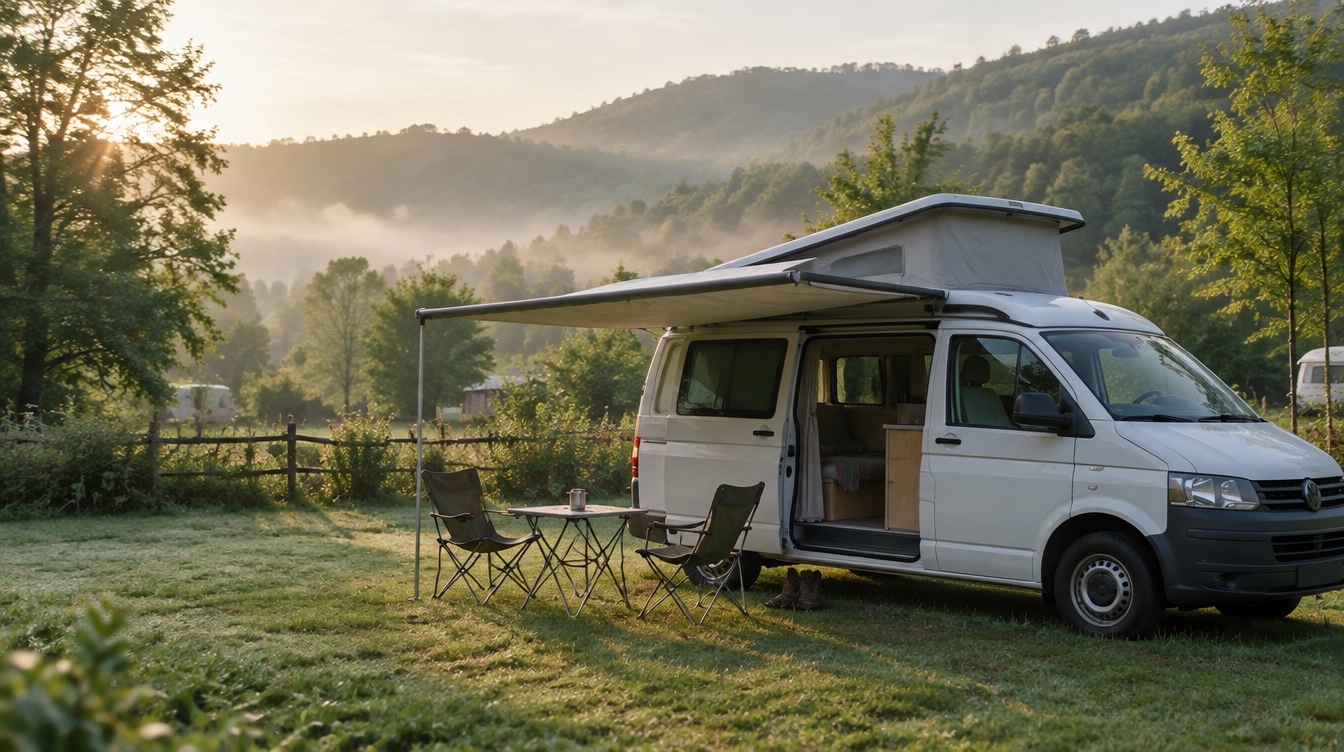
This image was generated with the help of AI.
Vanlife Tips for Beginners in Austria: What Nobody Tells You Before Your First Trip
Half past seven in the evening, somewhere on the B18. The sun has dropped behind the Gerichtsberg. You are driving through the Triesting valley on sidelights. And the site you looked up on your phone that morning is full.
Or closed. Or it only exists as a review from 2019. So there you are: the fridge needs power, the waste water tanks are full. And your passenger is asking how much longer this is going to take.
There is nothing adventurous about that situation. It is simply unpleasant. And it is avoidable.
My view after more than four decades with guests on the site: vanlife in Austria is not adventure roulette, it is a question of preparation. Anyone who thinks spontaneity is the heart of the matter is confusing freedom with having no plan. The people who arrive here relaxed sent an email the day before. The others ring at nine in the evening.
Here is the surprising part: the typical beginner mistakes almost never have anything to do with the vehicle. Your van is usually better prepared than your expectations. What goes wrong lies elsewhere:
- Wrong assumptions about pitches. A dot on the map is not a confirmation. Opening seasons, operating months and actual capacity are rarely stated where you are looking.
- Wrong assumptions about infrastructure. Electricity, drinking water and waste water directly at the pitch are the exception in Austria, not the rule. Many sites have a central service point. And in July it is occupied.
- Wrong assumptions about distances. Thirty kilometres to Vienna sounds like a quarter of an hour. On winding country roads in the Vienna Woods it is more like forty minutes. That is not a drawback, you just need to know it.
What follows are honest vanlife tips for beginners in Austria from the perspective of a site owner. No travel blog, no drone footage. Only what I hear from guests, ever since the first caravan stood here in 1980.
This is written for the people who actually call us. Couples over 45 travelling by van for a longer stretch for the first time. Retired people who can take their time and therefore want quiet. Travellers from Germany and the Netherlands looking for a stop on the way to Hungary or wanting to experience Vienna without a city hotel.
They all have one thing in common: they want technology that works and a quiet night. No entertainment programme, no mass processing. What that looks like in practice is described in our article about the campsite in the Vienna Woods, 30 km from Vienna.
Wild camping with a motorhome in Austria: the legal reality
Anyone driving through Austria with a motorhome for the first time soon hears the line: “You can pretty much park up anywhere anyway.” You cannot. The rules are made by the federal provinces and they differ a great deal.
In Lower Austria you cannot build a route across several nights on wild camping. That is not scaremongering, it is the legal situation plus the reality on the ground. Which is why this point comes first in any serious set of vanlife tips for beginners in Austria.
What matters is the difference between two things that many people lump together:
- Sleeping briefly in the vehicle so that you are fit to drive again. On permitted parking areas this is usually tolerated. You sleep, you drive on.
- Camping: awning out, table and chairs set up, step down, washing line strung up. From that point it is no longer a nap, it is camping. And that requires an area designated for it.
What is tolerated and what causes trouble
Usually tolerated: one night in a public car park with no prohibition sign, quiet, unobtrusive, gone in the morning. Trouble almost always comes from woodland, forest tracks and meadows without the landowner’s permission. Along with nature conservation areas and Natura 2000 zones.
Around Kaumberg this is particularly sensitive. Calcareous dry grassland and beech forests are protected here. So are species such as the marsh fritillary butterfly and the lesser mouse eared bat. A vehicle on an area like that is not a minor offence, it is an intervention in a Natura 2000 protected site. The Vienna Woods to the north of us are a biosphere reserve, where the same applies.
Why waste disposal is the real problem
Honestly: the fines are rarely the main issue. Grey water is. Washing up liquid, grease, shower water, toothpaste. If you let that run into the meadow, you are polluting exactly the soil that is protected here.
A regular site with a sewer connection is therefore not just more convenient. It is also the cleaner solution ecologically. With us, every pitch has electricity, drinking water and waste water disposal through the site’s own sewer system. Water and sewer use are included in the price. There is a reason we hold the EU Ecolabel.
My practical tip for route planning: enquire by email about two or three fixed sites per stage in advance. That beats hoping for luck. With us that works all year round at reservierung@camping-noe.at. If you need a quicker answer, just call. I pick up.
Pitches in Lower Austria: how to spot a good site before you book
You probably know the three most common annoyances already. Pitches where you cannot extend the awning without listening in on your neighbour. Sanitary facilities that have only been repainted since the eighties. And a phone number nobody answers.
So here is a counter model with numbers, so you have something concrete when comparing. With us in Kaumberg the pitches are around 90 to over 100 square metres. Every pitch has electricity, drinking water and waste water disposal through the site’s own sewer system. Around 50 tourist pitches are spread across a long, mostly level site, not a chessboard.
The sanitary building dates from 2005 and is accessible for people with disabilities. ADAC gave it five stars, and the Dutch ANWB rates it 8.3. We have held the EU Ecolabel since 2007. What that feels like day to day is described in our text about your pitch in the Vienna Woods.
Learn to read photos. On site websites you can see more than is written. Look at the distance between vehicles: are the motorhomes bumper to bumper, or is there a strip of meadow between them?
Pay attention to the ground. Gravel, grass, roots, gradient: that decides whether you need levelling ramps and whether you get wet shoes. And look at the trees and hedges. They are the only real screening a campsite can offer.
My view after many years on the site: the best quality signal is whether the owner can be reached. Someone who answers the phone beforehand will also answer when the electricity connection plays up. At Camping Paradise Garden you reach Leopold Grandl directly on +43 676 4741966. Reservations run all year round by email to reservierung@camping-noe.at. If you do not get a reply soon, please check your spam folder, that is where confirmations most often end up.
Questions to ask by email before you book
- How many square metres is the pitch, and will my vehicle of length X fit on it?
- Is the pitch level, or do I need levelling ramps?
- Electricity, drinking water and waste water at the pitch itself, or at a central point?
- How is electricity charged? With us by meter reading, 0.50 euro per kW.
- What kind of neighbours will I have? Long stay campers, tents, groups?
- Are dogs allowed? With us, yes.
Why cash only is not a warning sign
With us it is cash only, no card payment. That sounds old fashioned, but it is a deliberate statement. Small family businesses keep costs down this way, and the price stays the price, including tourist tax, waste fee and VAT. Simply bring cash, then checking out takes two minutes.
Motorhome kit: what you really need in Austria and what is just ballast
The packing lists online read as though you were driving to Mongolia. For Austria you need less, but the right things. After a few seasons in the Vienna Woods it is always the same four items.
Levelling ramps, because even a flat site has small slopes. A 25 metre cable drum, because the connection point is rarely where you park. A drinking water hose with the usual adapters; Gardena and three quarter inch cover almost everything. And a waste water container, in case your next site has no direct sewer connection.
Electricity, water, waste water: the three systems that count
With us every pitch has all three: electricity, drinking water and waste water disposal through the site’s own sewer system. Water and sewer use are included in the price, electricity is charged by meter reading at 0.50 euro per kW. That is fair, but it also means a fan heater in April eats more than you think. The boiler and the fan heater are the two big consumers. If you photograph the meter reading on arrival day, there is no discussion at the end.
One point many people underestimate. The wifi on site is free with 1 GB fair use. That is enough for weather, timetables and a few emails. It is not enough for two weeks of streaming. Plan for a data SIM if you are staying longer.
For the Vienna Woods itself
- A rain jacket worthy of the name, plus sturdy shoes. Around Kaumberg there are 52 kilometres of marked hiking trails, and the climb to the Araburg is slippery after rain. Which routes start right at the site is covered in the article on the campsite with hiking trails in the Vienna Woods.
- A head torch. The path to the sanitary building is dark at night, because there are no floodlights here.
- Insect screens for door and windows. A stream nearby, a meadow, a summer evening.
Dog owners and motorcycle travellers
Dogs are welcome. Bring a long lead for the meadow, a tick remover and a towel for wet fur. Sheep graze next door, which is an issue for some dogs.
Motorcyclists like to use the site as a base. Above all they need a stable stand plate so the bike does not sink into the meadow, plus a cover and a lock. The rest fits in the top case.
What can stay at home
Decorations, a third camping table, supplies for three weeks. Kaumberg has shopping within reach. There is an inn on site serving home cooking from its own kitchen. Ask about availability in advance and you can leave half your kitchen equipment behind.
Planning your route: Vienna, the Vienna Woods and the way towards Hungary
Looking for the one golden rule? Plan shorter stages than you think you can manage. Under 250 kilometres a day means you arrive in the afternoon, set up calmly and sit down to dinner instead of manoeuvring in the dark.
The final approach to the site belongs in daylight. Narrow valley roads, unlit turnings and a satnav that sends you down the nearest farm track. That is no fun at night, least of all with seven metres of vehicle.
This is how you get to Kaumberg. Into the satnav: Höfnergraben 2, 2572 Kaumberg, GPS 48.01972 / 15.9425.
- From the west (A1): exit St. Pölten Süd, B20 to Traisen (approx. 15 km), at the roundabout onto the B18 towards Hainfeld and on to Kaumberg (approx. 17 km). About 3 to 4 km after Kaumberg turn right, then 400 metres.
- From Vienna (A21): exit Mayerling, onto the B11 towards Hafnerberg, then the B18 to Altenmarkt, through the village, 1 km after Thenneberg turn left, then 400 metres.
- From the south (A2): exit Leobersdorf, via Berndorf onto the B18, 1 km after Thenneberg turn left.
Onwards to Hungary. From the site take the B18 to Günselsdorf, then head towards Eisenstadt and across the border. That is the shortest way and saves around 30 kilometres compared with the standard route.
My view on this: a stop with full infrastructure before the border is worth more than saving two hours. Fill up with fresh water, empty waste water into the sewer system, take a hot shower, use the electricity at the pitch. Once that is done, you drive on relaxed the next morning. And you do not have to hunt for a service point in Hungary.
Vienna without the vehicle. The motorhome stays where it is and you take bus line 169 (VOR) straight to Matzleinsdorfer Platz. The journey takes around 55 minutes, with roughly two to three departures a day. From there you change to the underground, the suburban railway or the tram.
Departure times change depending on the day of the week. So check vor.at, postbus.at or the ÖBB Scotty app before you set off. How to combine a day in the city with the site as your base is described in Camping in the Vienna Woods: your base camp for Vienna and nature.
For pilgrims: the Mariazell bus (VOR 552) connects Wien Mitte directly with Kaumberg. Handy if you are walking a section of the Via Sacra and coming back by bus or on the Mariazellerbahn via St. Pölten.
Camping etiquette: the unwritten rules that decide your reputation
My experience after many seasons: arguments on a campsite rarely start with noise. They start with carelessness. Anyone who spends twenty minutes reversing at one in the afternoon with the engine running has already introduced himself before saying hello. So plan differently during the midday quiet hours, switch the engine off, and have someone guide you in instead of using the horn.
Awning and porch stay on your own pitch. With 90 to over 100 m² per pitch there is enough room for that. Anyone who still spills over onto the neighbouring pitch takes away exactly what that neighbour booked.
Generator: unnecessary. Every pitch has electricity, billed by meter reading at 0.50 euro per kW. A running generator next to a power connection is a statement, and not a good one.
Grey water belongs in the sewer, not in the meadow. Every pitch has waste water disposal through the site’s own sewer system. The area lies close to Natura 2000 protected sites. Washing up water in the grass has no place here.
Dogs are welcome, but lead and bags are still compulsory. There is an active sheep farm right next door and the sheep graze in the meadows. A single loose dog is enough to send a flock into panic.
Fruit trees: around 120 old fruit varieties grow on the grounds, about 70 of which Leopold Grandl grafted and planted himself. No washing line on the branches, no pegs in the root zone.
At night: dim the lights, switch off the LED strings. And do not wash up at 11 pm, it carries further into the side valley than you think. Why this quiet matters to us is explained in A quiet retreat: camping in the Vienna Woods near Vienna.
And the long stay campers? No condescension, please. These people know every hiking trail and every bus line. They also know which summit is worth it even in fog. A friendly conversation at the fence replaces three search queries and delivers better vanlife tips for Austria than any forum.
Departure etiquette: how to hand back the pitch
Grey water and cassette emptied, power cable rolled up, pegs out, no rubbish in the grass. Waste goes to the collection point, and the waste fee is included in the price anyway. Payment is in cash, cards do not work, so get the money ready beforehand. And if you want an early start, settle up the evening before rather than knocking on the door at six.
Neighbours from other countries
Your neighbours are often Dutch and German; the ANWB rates the site 8.3. The website runs in German, English and Dutch, and reservations go to reservierung@camping-noe.at. A “Goedemorgen” opens more conversations than any language barrier closes.
Budget and extras: what beginners in Austria should expect
Let us be honest about the figures. With us a caravan or motorhome with two people costs 33 euro per night, a tent with two people 28 euro. Each additional person is 14 euro, a child between 5 and 13 is 6 euro per day. According to the price list there are reduced rates from 26 euro. If you are unsure whether that applies to your stay, just ask.
More important than the number itself is what is included. With us that means:
- Tourist tax, 2.50 euro per person per day
- Waste fee, 1.50 euro per person per day
- Water and sewer use through the site’s own sewer system
- VAT
The only extra is electricity, charged by meter reading at 0.50 euro per kW. So you pay for what you actually use. Not a flat rate that makes no sense for two nights in the low season. The complete, current list is at camping-noe.at/preise.
And now my view on it: sites that hide their extras end up costing you more. 22 euro on the sign, then shower tokens, a flat electricity charge, tourist tax on top, a dog fee, a wifi ticket. Anyone who only notices at reception that they are landing at 34 euro has saved nothing. They have simply planned worse. So never compare the base price, compare the total for your nights, your people and your electricity needs.
Then there is everything that happens before you reach the site. Budget realistically:
- Vignette: compulsory on Austria’s motorways. For short trips the 10 day or 2 month version is enough, prices at asfinag.at.
- Special tolls: some routes and tunnels cost extra and are not covered by the vignette.
- Fuel: a motorhome using 11 to 13 litres per 100 kilometres eats more budget than the pitches do. Planning standing time instead of kilometres saves the most here.
- Food: cooking for yourself with shopping in the village centre, plus an evening at the inn on site with home cooking. That keeps costs down without it feeling like a budget holiday.
Two more dates for your planning. The season runs from 30 March to 30 September 2026. We accept reservation enquiries by email to reservierung@camping-noe.at all year round. Please keep an eye on your spam folder if the confirmation does not arrive promptly. And one more point for your travel cash: with us payment is cash only.
My conclusion after more than 40 years on the site: drive slower, stay longer
If I had to pick a single one out of all the vanlife tips for beginners in Austria, it would be this: cut half of your route. The most common mistake is not the wrong equipment, it is the rush. Three nights, five provinces, filling up with water every morning and moving on. In the end you have plenty of kilometres in the logbook and not a single sunrise you watched in peace.
The alternative costs you nothing but the willingness to stay put. Find a place from which a lot is reachable and stay a week. From Kaumberg that looks like this:
- Vienna is around 30 to 35 kilometres away, by car or on bus line 169 to Matzleinsdorfer Platz, a journey of about 55 minutes.
- There are 52 kilometres of marked hiking trails in the municipality of Kaumberg alone.
- The Araburg, the highest castle ruin in Lower Austria at 800 metres, is about 1.5 hours on foot from the village centre.
- The Triesting and Gölsen valley cycle path runs 62 kilometres to St. Pölten, with connections towards the Traisen valley and the Danube.
- The thermal region, the spa town of Baden, the wine taverns in Gumpoldskirchen. And if you want altitude: Schneeberg at 2,076 metres, Rax at 2,007 metres.
That is more than you can manage in seven days. And every evening you drive back to the same pitch, with electricity, drinking water and a waste water connection right there. No setting up and packing down, no searching. No worrying about whether the next site has the sanitary facilities you have in mind.
I look at this with a longer time horizon than most. The farmstead here is first mentioned in the house chronicle in 1380, and it has been in family ownership for around 200 years. The campsite was added in 1980, and the current layout has been in place since June 2006. In between lie decades in which we rushed nothing. Living in nature with nature also means taking your time. That applies to fruit trees just as much as to travellers.
If you want to try it, send us an email at reservierung@camping-noe.at. If you would rather talk, or have a technical question about your vehicle, just call: Leopold Grandl, +43 676 4741966. And please check your spam folder if the confirmation does not arrive.
Frequently asked questions about vanlife in Austria
Do I have to use campsites to start vanlife in Austria, or can I park up freely?
Sleeping outside official sites is regulated differently in each province and municipality. In Lower Austria it is prohibited in many places. For beginners a regular campsite is the more relaxed option: you have electricity, drinking water and a legal night with nobody knocking on the door. At our site in Kaumberg every pitch has an electricity connection, drinking water and waste water disposal through the site’s own sewer system.
How much space should a pitch have so it does not get tight with a porch and awning?
Many large sites work with 60 to 80 square metres. Then your neighbour is practically standing under your awning. With us the pitches are approx. 90 to over 100 square metres, the grounds are mostly level and long, with trees and hedges in between. For a first trip that means manoeuvring without breaking a sweat and distance from your neighbour.
What does a night in a motorhome cost in Lower Austria, and what is included?
With us two people with a caravan or motorhome pay EUR 33.00 per night. Tourist tax, waste fee, water, sewer use and VAT are already included. Electricity is charged by meter reading at EUR 0.50 per kW. Important for your travel cash: we take cash only, card payment is not possible. The current list is at camping-noe.at/preise/.
Can I visit Vienna from the pitch without driving the van into the city every time?
That is exactly what our location is good for. Vienna is approx. 30 to 35 km away. Bus line 169 runs from the stops near Kaumberg straight to Matzleinsdorfer Platz, a journey of around 55 minutes. From there you change to the underground, the suburban railway or the tram. There are roughly two to three departures a day, and current times are on vor.at or in ÖBB Scotty.
I am travelling on towards Hungary. Is a stop in the Triesting valley worth it, or is it a detour?
Not a detour. The site lies on the shortest route for travellers heading to Hungary and saves around 30 km compared with the standard route. From the site take the B18 to Günselsdorf, then head towards Eisenstadt and on across the border. As a stop after a long stage it means a quiet night in a side valley instead of a service station beside the motorway.
What should I look for in sanitary facilities on my first van trip?
Do not just look at the overall rating, look specifically at the sanitary score. And at whether someone actively looks after the site. Our sanitary building was newly built in 2005, is accessible for people with disabilities and received five stars from ADAC. The ANWB rates the site 8.3. And if something comes up, Leopold Grandl can be reached on +43 676 4741966, not some hotline.
When can I book, and how does a reservation work?
The 2026 season runs from 30 March to 30 September 2026. We take reservation enquiries by email at reservierung@camping-noe.at all year round, and by phone on +43 676 4741966. If the confirmation does not arrive promptly, please take a look in your spam folder. More vanlife tips for Austria come as part of the same conversation.