
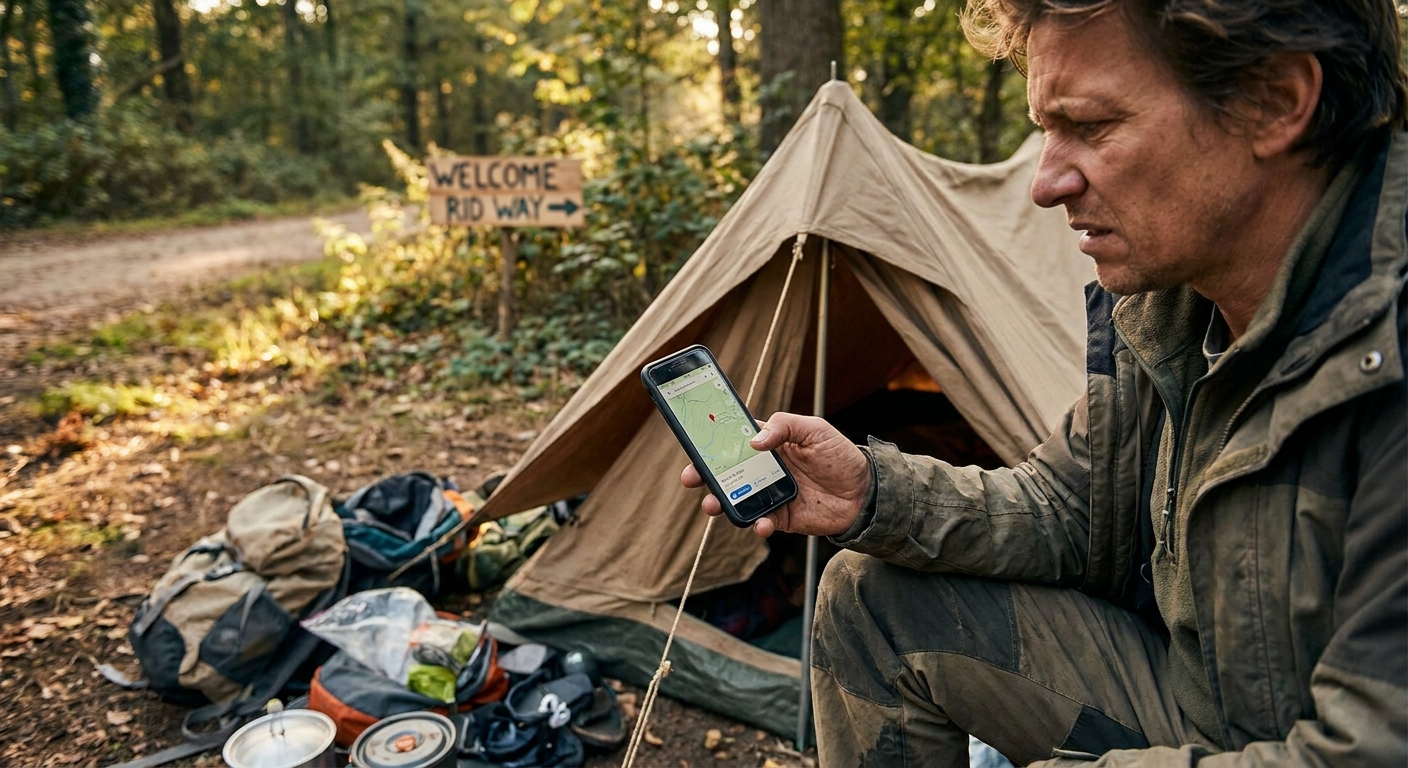
This image was generated with the help of AI.
“Campsite Near Me”: Why the Search Usually Ends in the Wrong Place
Why searching for a “campsite near me” says more about you than about the map
Your calendar is full, and so is your head. Thursday evening, half past ten, and you type into your phone: campsite near me. No guidebook, no dream destination, just that one phrase. And that is not a fallback at all.
I consider this search one of the smartest decisions you can make when camping. Do the sums: anyone who drives 600 kilometres spends two days in the car. There on the first day, back on the last. In between remains a leftover of rest that feels like an extension of the working week. Anyone who drives 30 kilometres is standing next to a pitched tent on Friday evening, with time for a drink before it gets dark.
With us it looks like this: Camping Paradise Garden, Höfnergraben 2 in Kaumberg, a quiet side valley in the southern Vienna Woods. Around 30 to 35 kilometres southwest of Vienna, set among meadows and mixed woodland, beside a mountain stream. Next door graze the farm’s sheep. Our guiding principle has stood above everything built and planted here since 1980: “Living in nature with nature.”
The journey to the site is part of the rest. Half an hour is enough for the meeting voice to fade. After Kaumberg you turn off, then another 400 metres, and the traffic is gone.
What this text is about: an opinion. Namely on what a campsite within reach actually has to deliver if it is to be more than a meadow with a barrier. Sanitary facilities where you do not queue in the morning. Pitches with real distance. Electricity, drinking water and waste water at the pitch. And people who can be reached when something comes up.
Where most sites near Vienna fall short is what we look at in the next section. Openly, even where it gets uncomfortable.
A campsite in the Vienna Woods: what the half hour drive does to you
The common assumption is that rest only begins after 800 kilometres. I consider that a mistake in thinking that costs many weekends. Anyone who drives eight hours brings the tension along and merely unpacks it later. The half hour from Vienna to Kaumberg does something different to you. It is short enough that you do not count it as effort, and long enough that the meeting voice falls silent. After the Mayerling exit, beyond Altenmarkt, at the latest on the final 400 metres into the Höfnergraben, the switch has flipped. If you are looking for a campsite near me, closeness is not a compromise, it is the actual advantage.
A side valley, no through traffic
The site lies in a quiet side valley of the municipality of Kaumberg, in the southern Vienna Woods. Meadows and mixed woodland all around, wooded hills on every side, a mountain stream at the edge. On the neighbouring meadows graze the sheep of the adjoining farm; the campsite belongs to a working sheep farm whose farmstead is first mentioned in 1380. The site is long and mostly level, with individual old trees and hedges. What is missing here is what you notice first: no through traffic, no background hum.
Nature conservation as a neighbour
North of the site the Vienna Woods begin as a biosphere reserve and Natura 2000 area. Protected here are calcareous dry grassland and beech forests, along with rare species such as the marsh fritillary butterfly and the lesser mouse eared bat. That is not a marketing argument but a framework: it explains why the surroundings stay so quiet and why the grounds have been developed since 1980 with respect for what was already there.
- Getting here from Vienna: about 30 to 35 kilometres, A21 to Mayerling
- Without a car: bus line 169 (VOR) to Matzleinsdorfer Platz, around 55 minutes, timetable at vor.at
- Tent with two people: EUR 28.00 per night, taxes included
Getting here and arriving: the last 400 metres
Anyone looking for a campsite near me usually wants to know one thing: how long am I in the car before I am parked up? The answer here is pleasantly short. And the last 400 metres are the nicest part of the route, because the valley narrows and the traffic simply stops.
- From Vienna (A21): exit Mayerling, on the B11 towards Hafnerberg, then the B18 to Altenmarkt. Through Altenmarkt, one kilometre after Thenneberg turn left, then around 400 metres to the site.
- From the west (A1): exit St. Pölten Süd, on the B20 for about 15 kilometres to Traisen, at the roundabout onto the B18 towards Hainfeld and on to Kaumberg, around 17 kilometres. Three to four kilometres after Kaumberg turn right, then those same 400 metres.
- From the south (A2): exit Leobersdorf, via Berndorf onto the B18, one kilometre after Thenneberg turn left.
For your satnav: Höfnergraben 2, 2572 Kaumberg. If the software argues with the house number, use the coordinates 48.01972, 15.9425. That works more reliably than any address search, especially on older devices that like to ignore side valleys.
My observation after many years: guests underestimate how much the driving time has to do with recovery. Half an hour from Vienna is short enough that you can still set off on Friday evening after work, and long enough that your head changes down a gear on the way. Five hours of motorway will not give you that. If you come without a car, take bus line 169 to Kaumberg, around 55 minutes from Matzleinsdorfer Platz. Current times are on vor.at or in ÖBB Scotty, and they change depending on the day of the week.
A side valley instead of the motorway verge
Anyone searching for “campsite near me” who lives in or around Vienna often lands on addresses that have more to do with traffic than with nature. A strip of grass beside a car park. A site on a through road where at night you hear the lorries changing gear. That is not camping, that is sleeping outdoors with background noise.
Our site lies in a side valley in Kaumberg, on the bank of a mountain stream, set among meadows and mixed woodland. No through traffic, because nothing passes through here. The site is long and mostly level, with individual old trees and hedges in between. A structure that has grown, not a grid drawn on a plan.
The difference shows in the number: around 50 guest pitches on grounds that would have room for considerably more. Each pitch is about 90 to over 100 square metres. In practice that means:
- You do not overhear the conversation at the next tent.
- Your guy lines do not collide with someone else’s.
- There is room for a table, chairs and a few steps without walking into anyone’s field of view.
- Electricity, drinking water and waste water disposal are right at the pitch.
That is a deliberate decision, and it costs revenue. Row upon row would be more profitable. But anyone who drives 30 kilometres out of the city to empty their head does not need a densely packed tent city. The site was laid out in 1980 with respect for nature, the current layout was completed in 2006, and the EU Ecolabel has confirmed this approach since 2007.
Next door graze the farm’s sheep. That is the noise level you have to expect here.
Camping near Vienna without a car: bus 169 instead of hunting for parking
A campsite near me also has to be reachable when there is no car in the driveway. For us that is not a footnote but a mark of quality. Anyone arriving with a rucksack, tent and sleeping mat should not be defeated by the journey.
There are three stops in the village: Kaumberg/Höfnergraben very close to the site, plus Kaumberg/Marktplatz and Kaumberg/Renzenhof. Bus line 169 of the Eastern Region Transport Association runs from here straight to Matzleinsdorfer Platz in Vienna.
- Journey time: around 55 minutes
- Frequency: about two to three departures a day
- Ticket: roughly 7 to 11 euro
- At Matzleinsdorfer Platz: connections to the underground, suburban railway and tram
Two to three departures a day means planning is part of it. Always check current departure times on vor.at, postbus.at or in ÖBB Scotty, as the times differ by day of the week. Do that once and you have no logistics questions for the rest of your stay.
The argument that matters more to us: the connection works in both directions. It is your way here without your own vehicle, and at the same time it is your day ticket into the city. From the tent to Schönbrunn, the Hofburg, the Prater or a wine tavern in the evening. No hunting for parking in the first district, no short stay zone, no fee calculator in your head.
For many guests that is exactly the reversal of the usual routine. Instead of staying in the city and driving out for nature, you stay on the meadow by the stream and go in for culture. In the evening the day does not end in a hotel room with street noise, but among meadows and mixed woodland, with the farm’s sheep as neighbours. If you like, you can simply stay put and let Vienna wait a day.
Camping in Lower Austria: how I recognise a good campsite
When you sleep in a tent, it is not the brochure that decides your night but the sanitary block. That is my conviction after many years on the site. In a motorhome you have your own shower. In a tent you walk barefoot across a meadow at six in the morning and then stand in front of a door behind which either warm water is waiting or a cold disappointment.
That is why I would have anyone looking for a campsite near me check these points first:
- Age and condition of the sanitary building. Ours was newly built in 2005, with modern showers and toilet rooms, accessible for people with disabilities. ADAC rated the sanitary building five stars, and the Dutch ANWB gives 8.3.
- Pitch size. Around 90 to over 100 m² per pitch. For tent camping that means distance from your neighbour, room for a porch and a washing line.
- How nature is treated. We first received the EU Ecolabel in 2007, the European Union’s highest environmental award. According to the province of Lower Austria, Kaumberg is one of the locations of the ten best campsites in the province.
- Reachability in an emergency, and a signal. We have had wifi since 2014, 1 GB fair use free of charge. Enough to load the hiking map and send the family a sign of life.
What you will not find with us
And now the other side. Anyone looking for an entertainment programme, a pool slide and evening shows is at the wrong address with us. There are sheep on the neighbouring meadows, a mountain stream, 120 old fruit varieties and, in the evening, the inn with home cooking from its own kitchen. That is the offer. Payment is cash only.
I think that is an honest selection. Anyone arriving with a tent usually wants exactly that: quiet, reliable infrastructure and nobody asking them to join in.
Electricity, water and waste water at the pitch
Anyone looking for a campsite near me mostly looks at photos and distance. But something else decides how the evening goes: the technology in the ground. With us every pitch has three connections, and not just the caravan pitches:
- Electricity right at the pitch, charged by meter reading at 0.50 euro per kilowatt
- Drinking water from your own tap, no hauling canisters across the meadow
- Waste water disposal through our own sewer system
Water and sewer use are included in the overnight price. So you only pay for what you actually use, and when tent camping that is usually little.
That is exactly the point many people underestimate. In tent camping, electricity is often seen as a luxury for motorhomes. I see it differently. A string of lights or a reading lamp in the porch changes the evening. The cool box keeps running, the butter stays butter, the beer stays cold. And the phone hangs on the socket instead of a power bank whose remaining charge you keep calculating in your head on day two. For pilgrims on the Via Sacra that is often the real reason for a night with us: shower, charge, move on.
The same infrastructure is used by caravans and motorhomes, which appreciate their pitches of 90 to over 100 square metres. And by motorcycle travellers who only pitch a small tent in the evening, take off the helmet and are glad that water and a socket are two steps away rather than two hundred metres.
One more thing, because it regularly causes surprise: we take cash only. Card payment is not possible with us, so please remember that before you set off.
A campsite with a dog and with children: sheep, meadow, 120 fruit varieties
Anyone looking for a campsite near me with a dog and children in tow often ends up on areas that are really car parks with a grass edge. Here it is different: the site belongs to a working sheep farm. The sheep graze not far from the pitches, and that is exactly the difference. Children watch instead of being entertained. Dogs are welcome.
Leopold Grandl tends around 120 old fruit varieties on the grounds. He grafted and planted about 70 of them himself. That is not decoration, that is decades of work. The farmstead first appears in the house chronicle in 1380, and it has been in family ownership for around 200 years. The first small campsite was created in 1980, and the current layout was completed in June 2006. Grown, not dropped in.
All around, Natura 2000 protects calcareous dry grassland and beech forests, along with rare species such as the marsh fritillary butterfly and the lesser mouse eared bat. That limits what can be built. For guests it means quiet that is not staged.
What families can expect here in practice:
- Meadows and forest to play in right at the site, with no programme
- 52 kilometres of marked hiking trails in the municipality of Kaumberg
- The Araburg castle ruin at 800 metres, the highest castle ruin in Lower Austria. From the centre of Kaumberg about 1.5 hours on foot across meadows and through mixed woodland
- The White Zoo with camel theatre in Kernhof, with white tigers, snow leopards and camels. Opening times and show dates are at weisserzoo.at
My view after many seasons: a farm is the best neighbour for a campsite. It brings sounds that calm children, and a rhythm that does not follow the booking situation. The dog can come. The phone can stay in your pocket.
What a campsite near me may cost
There is this quiet expectation: if a campsite is near me, it has to be cheap. Closeness as a reason for a discount. I consider that the wrong yardstick. A meadow that is maintained, a sanitary building that works, water, sewer and electricity at every pitch: that costs the same whether you have driven 30 or 300 kilometres. The better yardstick is transparency. You should know beforehand what will be on the bill at the end.
So here are the figures, valid from 30 March to 30 September 2026:
- Tent with two people: 28.00 euro per night
- Tent, per person: 14.00 euro
- Each additional person: 14.00 euro
- Child aged 5 to 13: 6.00 euro per day
- Caravan or motorhome with two people: 33.00 euro
The price list also carries reduced rates, for example 26.00 euro for two people with a tent. Which rate applies to your stay is best clarified directly with us before you book.
What matters is what is included. The tourist tax of 2.50 euro and the waste fee of 1.50 euro per person per day are included, along with water, sewer use and VAT. No recalculation at the barrier. The only extra is electricity, by meter reading and actual consumption. Anyone who sleeps two nights in a tent and plugs nothing in pays nothing for it.
One point we do not play down: payment is possible in cash only, we do not accept cards. That surprises some guests, so better read now than discovered on departure. Bring enough cash and settling up remains a matter of two minutes.
Prices change, and so do lists. The currently valid version is always at camping-noe.at/preise. Check there, then set off.
Via Sacra, cycle route and onward travel: the site as a stage destination
Not everyone who finds us searching for a campsite near me stays a week. Many come for one night because the journey continues. This site is in exactly the right place for that: directly on the Via Sacra, Austria’s oldest pilgrim route, which leads from Vienna via the Triesting valley and the Gerichtsberg to Mariazell.
For pilgrims that means in practice: a hot shower, a socket for the phone, free wifi with 1 GB fair use. Anyone arriving by car and continuing on foot can leave the car in our own car park by arrangement until they return. Getting here without a car works with the Mariazell bus, VOR line 552, from Wien Mitte directly to Kaumberg. The way back is by bus or on the Mariazellerbahn via St. Pölten. Always check current times on vor.at or in ÖBB Scotty, as the frequency is modest.
On two wheels, the Triesting and Gölsen valley cycle route is the obvious line: 62 kilometres from Hirtenberg or Leobersdorf to St. Pölten, along the riverbanks, through small villages. It links the thermal region route with the Traisen valley route, connection to the Danube cycle path included. Ending a stage here and pitching your tent makes more sense than a guesthouse in a town centre.
And for everyone heading towards Hungary: via the B18 to Günselsdorf, then towards Eisenstadt. That saves around 30 kilometres compared with the standard route. An overnight stop that costs nothing but the night itself.
What else is worth a visit along the way:
- Heiligenkreuz Abbey and the pilgrimage church of Klein-Mariazell
- Mayerling, steeped in history and close by
- Schneeberg (2,076 m) with its historic rack railway
- Rax (2,007 m) with cable car and views as far as the Hungarian plains
- Gumpoldskirchen and the wine taverns of the thermal region
- the spa town of Baden with summer operetta and casino
My conclusion: closeness is not a compromise
The best night in a tent is not the furthest away. It is the one that is still possible on Friday evening. Anyone who first needs three hours of motorway to earn their rest usually postpones it to sometime. And sometime is rarely this weekend.
That is why I do not consider searching for a campsite near me the budget version of a proper holiday. If you live in the greater Vienna area, Kaumberg lies 30 to 35 kilometres away in a quiet side valley by a mountain stream. Pitches of 90 to over 100 square metres, electricity, drinking water, waste water, a sanitary building that ADAC rated five stars. Plus sheep in the meadow next door, 52 kilometres of marked hiking trails and the Araburg at 800 metres. That is not a fallback, that is full equipment without the stress of a long drive.
A few practical points to finish, no pressure:
- Season 2026: 30 March to 30 September.
- Reservation: enquiries are possible all year round by email to reservierung@camping-noe.at. If no confirmation arrives promptly, it is worth checking your spam folder.
- Phone: +43 676 4741966. There you reach Leopold Grandl directly, for technical and personal questions alike.
- Payment: cash only, cards are not possible.
- Long stay camping: on request. The owner is best placed to discuss the terms with you himself.
- Without a car: bus line 169 runs from the village to Matzleinsdorfer Platz, current times on vor.at or in ÖBB Scotty.
The rest is simpler than it sounds. Tent, sleeping bag, a change of clothes, something to eat. What you do not have with you, you usually do not need here either. Pack light, leave a lot behind.
Frequently asked questions about a campsite near me
What does “campsite near me” mean if I am coming from Vienna?
For people from Vienna, near means 30 to 35 kilometres. Our site lies in Kaumberg in the southern Vienna Woods, in a quiet side valley beside a mountain stream. You drive half an hour, pitch the tent and you are out of the diary. The address for your satnav: Höfnergraben 2, 2572 Kaumberg.
What does a night in a tent cost?
Tent with two people: EUR 28.00 per night. Alone in a tent you pay EUR 14.00 per person, children aged 5 to 13 EUR 6.00 per day. Tourist tax, waste fee, water, sewer use and VAT are included, and electricity is charged by meter reading at EUR 0.50 per kW. The full list is at camping-noe.at/preise.
How do I reserve, and when are you open?
The 2026 season runs from 30 March to 30 September. We take reservation enquiries all year round by email at reservierung@camping-noe.at, and by phone you reach Leopold Grandl on +43 676 4741966. If no confirmation arrives promptly, please check your spam folder. Payment is in cash only, card payment is not possible.
How much space do I have for my tent, and what are the facilities?
The pitches are generously laid out at around 90 to over 100 m², and the site is long and mostly level, with individual trees and hedges. Every pitch has electricity, drinking water and waste water disposal through the site’s own sewer system. The sanitary building from 2005 is accessible for people with disabilities and was rated five stars by ADAC. There is free wifi with 1 GB fair use.
Can I get to the campsite without a car?
Yes. Bus line 169 of the Eastern Region Transport Association connects the stops near Kaumberg with Matzleinsdorfer Platz in Vienna, a journey of around 55 minutes, with about two to three departures a day. The Kaumberg/Höfnergraben stop is very close to the site. Current times and prices are on vor.at, postbus.at or in ÖBB Scotty.
Is the site worthwhile for pilgrims on the Via Sacra?
The campsite lies directly on the Via Sacra, Austria’s oldest pilgrim route to Mariazell. You can shower, charge your phone, use the free wifi and, by arrangement, leave your car at the site until you return. For part stages, the Mariazell bus (VOR 552) takes you from Wien Mitte directly to Kaumberg, and the way back is by bus or on the Mariazellerbahn via St. Pölten.