
This image was generated with the help of AI.
Keeping Your Motorhome Cool in Summer: 14 Methods That Really Work
Why a motorhome heats up so quickly in summer
One in the afternoon, 34 degrees in the shade. The vehicle has been standing in full sun since the morning. You open the habitation door and the first wave hits you like a hairdryer: 45 degrees inside, the plastic of the dinette smells warm, the cushion against the back wall is hot. Outside it is 34, inside eleven degrees more. That is not bad luck, that is physics. If you want to know how to keep a motorhome cool in summer, first look at where the heat comes from.
Where the heat really gets in (roof, windows, habitation door)
The biggest input comes from above. A dark metal roof or a GRP roof absorbs solar radiation and stores it. The surface easily climbs to 70 to 80 degrees and releases that heat inwards for hours, even in the evening when the sun is long gone.
- Roof hatches: acrylic glass lets radiation straight through. An open hatch without a cover acts like a magnifying glass on the seating area.
- Window surfaces: a lot of glass on little wall. Every unshaded window heats the space behind it.
- The cab: the windscreen is the largest uninsulated surface on the whole vehicle. Heat builds up behind it and migrates into the living area.
- Habitation door: thin, often dark, usually on the sunny side. An underestimated source of heat.
- Underbody: on asphalt a cushion of heat forms beneath the vehicle. The air there does not cool, it stagnates.
Why bodywork temperature and interior temperature are two different things
The outer skin reacts fast. It gets hot as soon as the sun is on it and cools as soon as a cloud comes. The interior reacts slowly. Furniture, upholstery, the water tank and the walls absorb heat over hours and release it over hours. That is why at nine in the evening it is often still warmer inside than outside, even though the sun has gone.
From this follow three levers for keeping a motorhome cool in summer, and the rest of this article is structured around exactly these:
- Keep radiation out: location, shade, insulating mats, thermal curtains.
- Remove heat: cross ventilation, roof vent, fan, the right times of day.
- Do not let heat in at all: insulation, cooking habits, fridge ventilation, electricity at the pitch.
The pitch is the strongest lever: shade, orientation, altitude
No fan and no air conditioner can recover what a bad pitch gives away. When keeping a motorhome cool in summer, the most important decision is made in the first five minutes after arrival: where the vehicle stands and how it stands.
Align by the sun, not by the view
A beautiful view tempts you to turn the big window side to the west. That is exactly where the sun burns hardest from three in the afternoon. Better:
- Long side with the large windows facing north. Practically no direct sun hits the glass there.
- Cab into the afternoon sun. The cockpit heats up anyway, but it can be sealed off with a thermal mat and you do not sleep in it.
- Awning side facing southwest or west. That way the awning shades exactly the area where you sit in the evening.
- Check the day before where the sun rises in the morning. A sleeping spot in full sun from six o’clock ruins the last hour of sleep.
Why cramped pitches make the heat worse
If the neighbouring vehicle is two metres away, you have a second heating surface beside you. Heated metal keeps giving off warmth for hours after sunset, and the airflow between the vehicles stalls. On pitches of around 90 to over 100 m², as is standard in Kaumberg, that does not happen. There is distance to the neighbour, the air moves through, and the awning can be fully extended without touching the next pitch. Exactly this combination of distance and shading lowers the interior temperature far more than any additional device. What such a pitch in the Vienna Woods looks like in practice is shown on the site page.
Ground, trees and the stream nearby
Gravel and asphalt store heat and radiate it back from below. Grass does not, it even cools slightly through evaporation. The site in Kaumberg lies on meadow ground in a quiet side valley of the southern Vienna Woods, with individual trees and hedges between the pitches and wooded hills all around. Add to that a mountain stream at the edge of the grounds; flowing water and woodland keep the ambient temperature noticeably below that of open ground.
The second point is altitude. The Vienna basin traps the heat, while in the Vienna Woods it cools down at night. For visitors to Vienna that means: 30 to 35 kilometres from the city, sightseeing by day, cooler nights in the evening. More on that in the article on the campsite in the Vienna Woods, 30 km from Vienna.
Insulating a motorhome against heat: using thermal mats, foils and curtains properly
Passive heat protection uses no electricity and works immediately; for keeping a motorhome cool in summer it is the cheapest lever of all. The order matters: what you keep out on the outside, you no longer have to cool away on the inside. And the most important moment is not the afternoon, but the moment in the morning when the outside air becomes warmer than the air in your vehicle. From then on, everything stays shut.
Outside before inside: the windscreen first
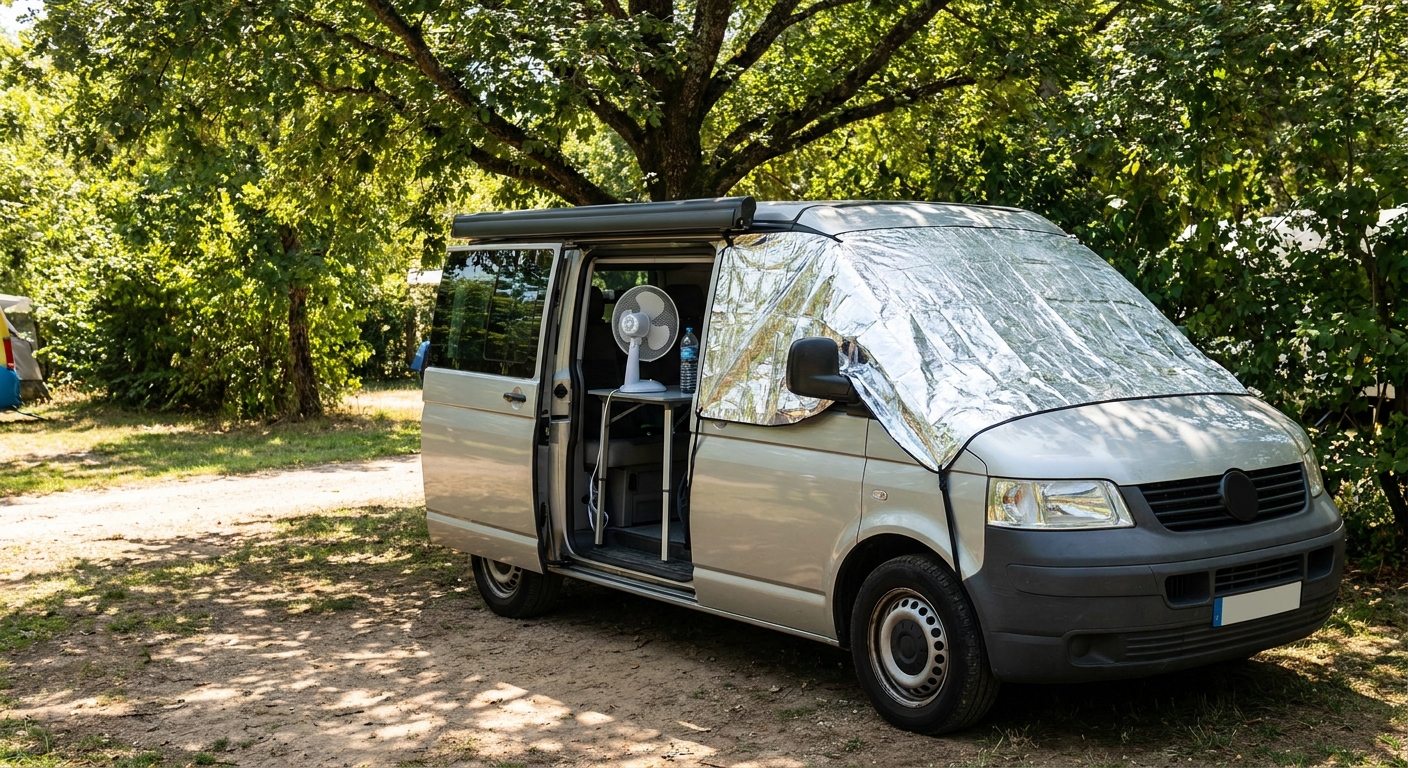
The windscreen is the biggest weak point. It is huge, sits at an angle to the sun and heats the cockpit to over 50 degrees in no time. An external insulating mat beats any interior mat by a wide margin, because the radiation never gets through the glass in the first place. With interior mats the glass still gets hot and releases the heat inwards.
- Pull the external mat over the windscreen and side windows, close the doors, fix with straps or magnets.
- Close the cab curtain between cockpit and living area. The cab is a thermal bridge; sealed off, that saves noticeable degrees.
- If you have no external mat: interior mat plus cab curtain, and park the vehicle so the front is in the shade.
Shading roof hatches and windows
After the windscreen comes the roof. Roof hatches let radiation into the vehicle vertically, especially between 11 am and 4 pm.
- Lay or clip reflective covers on the outside of the roof hatches. The internal blind alone is not enough.
- Keep window blinds closed during the day, even on the shaded side. Blackout reduces scattered radiation.
- Do not forget the habitation door: a dark curtain or a cut to size mat in front of the door window takes out a fair amount.
- Emergency fix on the road: light coloured towels or reflective foil on the roof, secured to the rail with a few clips. Looks improvised, but measurably lowers the interior temperature.
Awning, sun sail and the mistake with the windbreak
Shade in front of the vehicle works better than any cover on the wall. Extend the awning where the sun is, and a sun sail adds area over the entrance side. But mind the air: the most common mistake is placing the awning and windbreak so tightly that heat builds up underneath and the cross ventilation at the vehicle breaks down. Leave the sides open and only raise the windbreak when it is windy.
A site with generous pitches and individual trees helps more here than any technology. On around 90 to over 100 m² per pitch you have room for awning and sun sail and still distance to your neighbour.
Air conditioning in a motorhome: roof unit, locker unit or portable solution
Three designs, three very different compromises. Anyone relying on technology to keep a motorhome cool in summer and spending a lot of time on pitches with mains power has a free choice. Anyone travelling off grid has to do the sums honestly.
Which design suits which travel style
- Roof air conditioner: cools fastest and distributes the air evenly across the ceiling. In return, 30 to 40 kilos go up top, the vehicle height grows by around 20 to 25 centimetres and the unit sits acoustically right above the seating area. Light sleepers notice it at night.
- Locker air conditioner: the weight stays low, the centre of gravity is right, the headroom is unchanged. Inside it is usually quieter because the compressor is decoupled. The price: a whole locker is gone, and the installation with air ducts costs workshop time.
- Portable monobloc: cheap to buy, can be removed at any time. Stands or falls with the exhaust air routing, though. If you just hang the hose out of a tilted window, you draw the warm air straight back in and cool practically nothing. You need a sealed window panel or a fixed outlet to the outside.
Calculating power consumption realistically
A typical unit draws 0.7 to 1.2 kW in continuous operation, depending on output and outside temperature. With us in Kaumberg electricity is charged by meter reading at 0.50 euro per kW, and water and sewer use are included in the overnight price. That makes a rough estimate easy: if the air conditioner runs for four hours on a hot afternoon at around one kilowatt, you end up at about two euro. No cause for panic, but good to know before the bill comes.
Running it from an inverter and the leisure battery is usually unrealistic for continuous cooling. One hour of cooling eats roughly 80 to 100 amp hours from a 12 volt bank. For a whole night you would need a lithium system of a size rarely fitted in a motorhome. A compromise: cool down on mains power in the afternoon, run only the fan at night.
Mains power, fuses and consideration for the neighbours
Every pitch with us has its own electricity connection, plus drinking water and waste water disposal through the site’s own sewer system. Still, watch the starting current: compressors draw far more at start up than in operation, and if the boiler and kettle are running at the same time, the fuse trips. Switching devices on with a time gap helps.
And on night time quiet: your neighbour hears the outdoor unit too. With us the pitches at 90 to over 100 square metres are well apart, which takes the edge off. Technical questions about the connection are best clarified in advance with Leopold Grandl on +43 676 4741966.
Keeping a motorhome cool without air conditioning: airflow, fans and night cooling
Most motorhomes have no roof air conditioner, and that need not be a problem: keeping a motorhome cool in summer also works without a compressor. What matters is when you ventilate and when you consistently shut everything. Warm air rises, cool air stays low. That is exactly the chimney effect you use: roof vent open, one window open on the opposite, shaded side, and you have a draught through the vehicle.
The 24 hour ventilation plan
- Evening after sunset: open everything. Roof vent, windows, rear doors with insect screen. Now the cool air comes in.
- At night: leave the roof hatch open, pull the insect screen across. In the side valley the temperature drops noticeably after sunset, as the cold air slides down from the wooded slope into the valley.
- Morning between 7 and 9: everything shut. Windows closed, blackout and thermal mats down, including inside on the windscreen.
- During the day: keep it closed and park in the shade. Only air briefly if it gets stuffy inside.
- Late afternoon: as soon as the outside air is cooler than the inside air, open up again. A thermometer inside and outside helps with the timing.
In the city this plan often fails because the asphalt gives off heat until midnight. With us in Kaumberg, in the side valley between meadows and mixed woodland by the mountain stream, it cools down considerably after sunset. And because the site is quiet, you can really leave the hatch open without traffic or neighbours two metres away keeping you awake. What that feels like is described in the article on the quiet retreat in the Vienna Woods. Around 90 to over 100 square metres per pitch make a difference there.
Fans that actually make a difference
- Roof fan with extraction: pushes the warm air out at the top and draws cool air in through the lower windows. The most effective single item.
- 12 volt fans: economical, often under 15 watts. Two small ones in different places do more than one in the living area.
- Clip on fan above the bed: air movement on the skin lowers the perceived temperature by several degrees, even if the thermometer stays the same.
Electricity is available at every pitch, charged by meter reading at 50 cents per kilowatt hour. A fan running half the night barely registers.
Evaporative cooling and keeping humidity under control
A damp towel hung in front of the fan noticeably cools the air flowing through. That only works with dry air and simultaneous air exchange, though. Otherwise the moisture collects in the vehicle and you wake up the next morning in a steam bath. Rule of thumb: use the towel only while roof hatch and windows are open, and take it down overnight.
The fridge in a motorhome in the heat: how to keep it reliably cold
From around 30 degrees outside, the fridge becomes the main annoyance when keeping a motorhome cool in summer. The butter goes soft, the beer lukewarm, and the display still says level 5. That is rarely a fault, mostly physics and positioning.
Absorption or compressor: the difference in the heat
The absorption fridge works with heat instead of a motor. Gas, 230 volts or 12 volts heat an ammonia solution, and the heat leaves through a grille on the outside wall of the vehicle. The hotter the air there, the worse exactly that works. Rule of thumb: an absorption fridge manages roughly 25 to 30 degrees of difference from the ambient temperature. At 35 degrees in the shade it gets tight inside. For safe storage the EFSA recommends keeping food at a maximum of 5 degrees.
The compressor fridge hardly knows this problem and cools constantly even in the heat, but it needs electricity for that. On mains power that is uncritical. With us consumption is charged by meter reading at 50 cents per kilowatt hour, and every pitch has its own connection. Anyone spending a lot of time off grid should keep an eye on battery capacity: a compressor draws considerably more on hot days because it runs longer.
Ventilation, orientation and loading
- Put the fridge side in the shade. When parking, think briefly about where the afternoon sun will be. On our pitches of 90 to over 100 square metres you have enough room to turn the vehicle accordingly.
- Keep the ventilation grilles clear and shaded. No bikes, awning parts or boxes in front of them. A light coloured cover or a piece of foam mat above the upper grille noticeably lowers the temperature behind it.
- Retrofit extra fans. Two small 12 volt fans on the condenser cost little and often gain several degrees. On a thermostat switch they only run when needed.
- Level the vehicle. An absorption fridge genuinely needs that, otherwise the cycle stalls. A spirit level rather than guesswork, levelling ramps if necessary.
- Do not overfill. The air has to be able to circulate.
- Never put in warm food, load drinks pre chilled and open the door briefly and rarely. Anyone standing in front of it three times a day for a long time loses more cold than any insulation can make up.
And on really hot days: there is an inn on site with home cooking from its own kitchen. Then the stove stays off and the fridge stays half empty. Please ask Leopold Grandl about availability in advance on +43 676 4741966.
Plan the day around the heat instead of enduring it
Air conditioning, insulation, awning: all of it helps. But the simplest measure brings the most, namely shifting the daily routine. When keeping a motorhome cool in summer, the calendar often works harder than any device. Anyone travelling in a motorhome in summer does not have to be active between one and five in the afternoon. Those hours belong to the shade.
Out in the morning, into the shade at midday
Between seven and half past nine the air in the Vienna Woods is still cool, often below 20 degrees. That is the time for everything that takes effort:
- Araburg: from the centre of Kaumberg follow the green markings, around 1.5 hours on foot up to 800 metres. The highest castle ruin in Lower Austria. Anyone starting at seven is back down before the midday heat.
- 52 km of marked hiking trails around Kaumberg, much of it through mixed woodland. The beech forests in the Vienna Woods Biosphere Reserve are noticeably cooler than open ground on hot days, often by five to eight degrees. Which loops start right at the site is on the page about the campsite with hiking trails.
- Triesting and Gölsen valley cycle route: 62 km from Hirtenberg to St. Pölten, along the riverbanks. A part stage in the morning is plenty, the rest can be done another day.
From midday back to the pitch, awning out, a book or a nap. With around 90 to over 100 m² per pitch you are not standing in the waste heat of the neighbouring vehicle, and the trees and hedges on site make the difference. From about five in the afternoon it becomes pleasant again: a walk to the sheep, an evening round through the orchards, home cooking at the inn.
A day in Vienna as a heat escape
On days with 34 degrees, Vienna is a better idea than any hike. Museums, the Imperial Crypt, the opera: all air conditioned, all indoors. Bus line 169 runs from the stops near Kaumberg straight to Matzleinsdorfer Platz, a journey of around 55 minutes. From there you continue by underground, suburban railway and tram. How to plan such a day is shown in the article Camping Vienna Woods: Your Base for Vienna Trips and Hiking Adventures.
The big advantage: the motorhome stays in the shade, nobody fights an overheated cab in a traffic jam. There are only about two to three departures a day, though, and the times differ by day of the week. Check the timetable beforehand on vor.at or in the ÖBB Scotty app and plan the return trip at the same time.
For travellers heading to Hungary: driving stages belong in the morning hours. Set off at six, before the asphalt and the interior heat up. From the site along the B18 to Günselsdorf, then on towards Eisenstadt. This route is around 30 km shorter than the standard version, so half an hour less heat in the cab.
Checklist: kit and pitch criteria for hot weeks
What belongs in the motorhome before you set off
Most of this is small, light and costs money once. After that, keeping a motorhome cool in summer is a routine on every high summer day rather than a building site.
- External thermal mats for windscreen and side windows. Fitted outside they work far better than interior mats, because the heat never reaches the glass.
- Roof hatch cover in a light colour. The roof vent is the biggest heat source above you.
- 12 V fan, ideally two: one pushes air in, one pulls it out. Cross ventilation beats any single fan.
- Extension cable and CEE adapter, at least 25 metres. On generous pitches the post is not always right next to the vehicle.
- Sun sail with guying set, including pegs for meadow ground and storm straps.
- Thermometer for inside and outside. Only when you see the difference do you know when ventilating makes sense.
- Cool packs for pre cooling the compressor fridge, especially handy after shopping.
- Water supply: tank full plus a few litres of drinking water separately, for the dog, coffee and cold cloths on the back of the neck.
What to look for when enquiring about a site
Before reserving, a comparison is worthwhile. These points decide whether a hot week is relaxed or a grind.
- Pitch size: under 80 m² it gets tight once the awning and sun sail are up. With us the pitches are around 90 to over 100 m², on about 50 guest pitches.
- Trees: individual trees and hedges give shade without blocking the satellite dish. The site is long, with meadows and wooded hills all around.
- Ground: grass stores less heat than gravel or asphalt and does not raise dust.
- Electricity at the pitch: without your own connection there is no continuous running of fridge and fan. With us every pitch has electricity, charged by meter reading.
- Drinking water and waste water right at the pitch: no manoeuvring to a central point at 33 degrees. We have a drinking water connection and waste water disposal through the site’s own sewer system at every pitch.
- Sanitary quality: a cold shower in the evening is half the night in summer. Our sanitary building from 2005 has 5 ADAC stars, and the ANWB rating is 8.3. Plus the EU Ecolabel.
- Reachability of the owner: ask beforehand who answers the phone for technical questions.
Dogs are welcome, and wifi with 1 GB fair use is free. The season runs from 30 March to 30 September 2026. Reserve by email at reservierung@camping-noe.at; please also check your spam folder if the confirmation does not arrive. Payment is cash only.
And then the motorhome stands in the shade, you can hear the stream, the sheep graze next door. The heat stays outside. You stay seated.
Frequently asked questions
What helps most when keeping a motorhome cool in summer?
Shade and airflow beat any technology. Park the vehicle so that the long side with the large windows is not in the midday sun, and open the roof hatch plus two opposite windows for cross ventilation. Then comes insulation: thermal mats on the outside of the windscreen, reflective foils in the roof hatches. Air conditioning or fans then have far less work to do.
How important is the pitch itself for the temperature in the vehicle?
Very important. On cramped pitches the vehicles stand so close that the neighbours’ waste heat lingers and the awning barely has room. With us in Kaumberg the pitches are cut at around 90 to over 100 m², with individual trees and hedges in between that cast shade in the afternoon. The site lies in a quiet side valley on the bank of a mountain stream, surrounded by meadows and mixed woodland, and you notice that in the evenings.
Do I need a particular power supply for an air conditioner?
Every pitch with us has its own electricity connection, plus drinking water and waste water disposal through the site’s own sewer system. We charge electricity by meter reading at EUR 0.50 per kW, so you only pay for what you actually use. Anyone running the air conditioner for longer should factor that in. A roof fan gets by on a fraction of it.
How do I get the motorhome cool at night?
At sunset open everything that has screens: roof hatch, windows, habitation door with insect screen. Warm air sits at the top, so the open roof hatch draws it out most effectively. Textiles such as seat cushions and mattresses store heat, so start ventilating early and not just before going to bed. At altitude in the southern Vienna Woods it usually cools noticeably in the evening, which takes a lot of the work out of keeping a motorhome cool in summer.
What do I do with the fridge in the heat?
Absorption fridges lose performance above 30 degrees outside, especially when the ventilation grilles are in the sun. Park the vehicle so the fridge side is in the shade, and keep the grilles clear of towels or storage boxes. On mains power the fridge runs more stably than on gas or 12 V. Only rearrange food once a day, every opening costs cold.
Is a site in the Vienna Woods worthwhile as a summer base for visiting Vienna?
If you want to see the city by day and sleep in the cool by night, yes. From Kaumberg it is around 30 to 35 km to Vienna, and bus line 169 runs from the stops near Kaumberg straight to Matzleinsdorfer Platz, a journey of about 55 minutes, two to three departures a day. Current times are on vor.at or in ÖBB Scotty. Questions about the site are answered directly by Leopold Grandl on +43 676 4741966.