
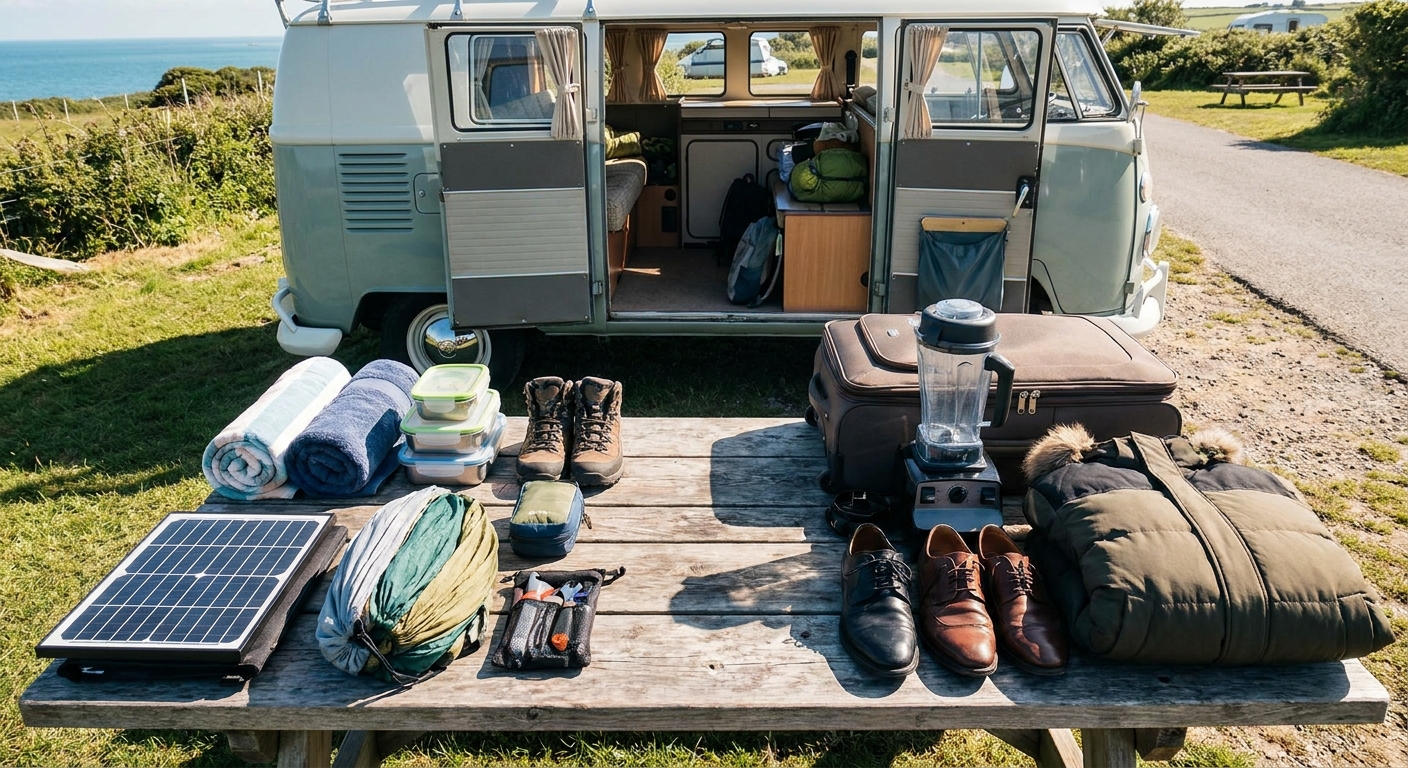
This image was generated with the help of AI.
Campervan Packing List for Summer: What Is Different in July Compared to April
Meadow, forest, a few sheep next door. And you are standing in front of it all with half packed boxes. Why did three head torches make it in, but no mosquito net? That is exactly where the difference between spring and high summer begins.
A summer campervan packing list is not a slimmed down spring list. In July the vehicle heats up over the course of the day. Food keeps for less time, and water consumption doubles quickly: showering, washing up, watering.
Then there are mosquitoes and ticks. Long evenings outdoors need light, seating and shade. And with two people plus crates of drinks, storage space fills up faster than you expect. In high summer the payload is the quiet stumbling block.
That is why this summer packing list is sorted by area rather than alphabetically. Packing alphabetically means packing twice: two lighters, three rolls of bin bags, no adapter. Sorted by area you see immediately what is missing.
A second point that often gets overlooked: your list depends on the campsite. If every pitch has electricity, drinking water and waste water disposal, as ours do in Kaumberg, you need no chain of canisters and no collection of power banks. Other things become important instead: a longer power cable, a water hose with the right connector, and a waste water hose that reaches the sewer connection.
Calculating the payload honestly
Work with full equipment, not wishful thinking. That means: spare wheel, full fresh water tank (100 litres is 100 kilos), two people, gas bottles, crates of drinks. A crate of mineral water weighs around 15 kilos. Three of them are half an adult.
- Rule of thumb: before your first trip, drive onto a public weighbridge fully loaded and read the axle loads separately.
- Water: at sites with a connection at the pitch, travel with the tank half full and top up on arrival.
- Reserve: leave at least 50 kilos of buffer for shopping along the way.
Pack by area, not by feel
Five boxes, five responsibilities. Each box has a fixed place in the vehicle and stays there all season.
- Kitchen: crockery, stove, supplies, cool box accessories.
- Technical: power cable, adapters, water hose, tools.
- Outdoors: awning accessories, chairs, table, levelling ramps, light.
- Bathroom: shower kit, towels, sanitary fluid, cleaning supplies.
- Clothing: one bag per person, rain and hiking gear packed separately.
Heat, shade and sleep: summer kit for the inside of the vehicle
A panel van in the July sun turns into an oven. Forty degrees inside at three in the afternoon, and in the evening the metal cools down only slowly. The good news: a few kilos from this summer packing list keep it bearable inside. Without air conditioning and without constant noise.
Shading that actually works
The biggest lever is the windows. Thermal mats fitted to the outside of the windscreen do far more than interior mats, because the heat never reaches the glass in the first place. Add mats for the side windows of the cab. Those small surfaces heat up more than you would think.
- A sun sail or a light awning for the side you sit on
- A reflective cover for the roof hatch, the hottest surface in the vehicle
- A small USB or 12 V fan, ideally with a clip for a cupboard or the roof hatch
- A thermometer with hygrometer, so you are not guessing when it is worth ventilating
When parking, orientation counts. Rear or front facing south, the large side wall with the windows facing north. That way the midday sun hits the smallest surface.
In the morning between six and nine, open everything: sliding door, rear doors, roof hatch. The cool night air is free. After that, close up and shade.
What helps here: generous pitches with individual trees and hedges, like the ones we have in Kaumberg at around 90 to over 100 square metres each. Real tree shade cools differently from an asphalt row, where five vehicles throw the heat back at each other.
Sleeping at 25 degrees in the van
The winter duvet stays at home. Bring thin cotton or linen bedding. Linen feels cooler on the skin straight away and wicks sweat away faster.
Add a light summer blanket, or at a pinch just a cotton sheet. In the heat, a second set of bedding is not a luxury but hygiene. Pillows with spare covers belong on the list too. If you are a sensitive sleeper, put a thin natural fibre topper rather than foam directly on the mattress.
Insect protection without chemical overkill
By the stream and on the meadow, mosquitoes are out in the evening. A mosquito net for the sliding door and rear doors solves that elegantly. You can leave everything open all night without spraying anything inside the living space.
Magnetic versions hold well on metal. For the rear doors a model with an elastic band is more practical. Add a fine net for the roof hatch: the draught stays, the insects stay out.
Summer motorhome packing list: electricity, drinking water and waste water
With the supply systems, mistakes catch up with you fastest. A cable that is too short, a missing adapter, and you are standing at your pitch improvising. So here is the list that really gets used with us in the Vienna Woods.
Cables, adapters and what is actually available at the pitch
An extension cable with a CEE plug, at least 25 metres. Anything shorter often gets tight once you position the vehicle so the awning faces the meadow.
- CEE to Schuko adapters in both directions
- A cable drum, always fully unwound, otherwise it gets warm
- A rubber mat or plastic box for plug connections lying in the grass
With us, every pitch has its own electricity connection. Electricity is charged by meter reading at 0.50 euro per kW. That sounds like a detail, but in summer it makes a difference: you pay for what you use.
So you do not have to work out whether the compressor fridge at 30 degrees will blow a flat rate budget. Charge the power station, run the air conditioner, use the coffee machine without a guilty conscience. That is exactly why the second charger can come along too.
Drinking water: hose, adapters, tank care
- A food grade drinking water hose, 10 to 15 metres, stored separately from the waste water hose
- Various tap adapters, the Gardena system plus threaded adapters
- A watering can or folding canister as a reserve for the night
- A water filter or silver stick for tank care, more important in summer than in spring
- A measuring jug, so you are not guessing how much is already in the tank when filling up
Warm water in the tank goes off faster. Flush the tank once before the trip. On the road, top up smaller amounts more often rather than leaving it standing full to the brim. Every pitch here has a drinking water connection, so you stay flexible.
Waste water and toilet chemicals in summer
- A waste water hose plus a flat drainage tray
- Sanitary fluid for the cassette, dosed more generously in summer
- Disposable gloves and a separate cleaning product just for the cassette
With us the waste water drains away right at the pitch through the site’s own sewer system. No hauling canisters across the meadow, no queuing at a central station. Shower in the van, wash up, done. Water and sewer use are included in the price.
Kitchen and supplies: summer camping kit for freshness without stress
In July the kitchen equipment decides whether you cook in a relaxed way in the evening or throw food away. The kitchen section of a summer packing list is shorter than many people think. What matters is that every item genuinely works.
Cooling, so the salad does not turn
A compressor cool box or a fridge is not a gadget at 30 degrees. It is the difference between fresh cold cuts and a stomach ache.
Put a small thermometer inside and check the reading each morning. Below 7 degrees is the target. At the pitch the electricity connection helps, so you are not draining the leisure battery overnight.
Then there is the inventory that fits in any rear garage:
- Stackable crockery, four plates, four bowls, you need no more than that as a couple
- One sharp knife instead of five blunt ones, plus a chopping board with a juice groove
- One pot, one coated pan
- A kettle: with mains power the fastest solution for tea, coffee and pasta water
- A stovetop espresso maker for the gas hob
- Storage containers with seals, because in summer ants find every open packet
- Food bags for leftovers and cut fruit
- A washing up bowl, two or three microfibre cloths, bin bags
Supplies that survive 30 degrees
Plan your shopping so the fridge has room to breathe. Hard cheese keeps far longer than soft cheese. Tins of beans, tomatoes or fish save every evening when nobody feels like cooking.
Pasta, rice, couscous, good oil, salt and a few spices: that gives you a meal in 20 minutes. Fruit such as apples, oranges and melon handles heat better than berries.
One tip that saves a whole day of cooking: there is an inn on site serving home cooking from its own kitchen. Plan one evening there and shop accordingly. Availability changes with the season, so ask in advance by phone on +43 676 4741966 or by email at reservierung@camping-noe.at.
Drinks: quantities, bottles, storage
Count on at least two litres per person per day, plus a reserve of five to six litres in the vehicle. On hot hiking days towards the Araburg that quickly doubles. Drinking water is available right at the pitch, so you are not hauling crates, you top up as needed.
Two insulated bottles per person are the best investment: one for cold water, one for morning coffee. Crates of drinks belong flat in the double floor or behind the axle, not in the rear. You notice the difference on the B18 in every bend.
Clothing, washbag and first aid kit for hot days and cool nights
In the side valley near Kaumberg there is easily a dozen degrees between the midday heat on the meadow and the evening by the stream. Anyone who packs only shorts and T-shirts will be sitting shivering outside the motorhome at nine in the evening. So even in July the rule is: bring layers, not more fabric.
Clothing: layers instead of suitcases
- Shorts and long trousers, two pairs of each are enough for a week
- Light long sleeved shirts, they protect against the sun by day and the mosquitoes by the stream in the evening
- A rain jacket for the afternoon thunderstorms that pass through the Vienna Woods regularly in summer
- A fleece or thin down jacket for evenings in the valley
- Hiking boots for the 52 km of marked trails around Kaumberg and the climb to the Araburg, plus sandals for the site
- Swimwear and a beach towel for the thermal region to the east
- A hat or cap, there is little shade on the open meadow sections
Washbag and laundry on site
The sanitary building was newly built in 2005. It is accessible for people with disabilities and received five stars from ADAC. For your packing list that means: no mobile shower solution, no outdoor shower bag, no improvised hot water setup. The showers and toilets are there, they work and they are clean.
What you bring yourself:
- Your own set of towels per person, plus a small extra towel for wet hiking boots
- A hanging shower bag so you are not carrying loose bottles across the site
- Flip flops
- A washing line and a few pegs, on hot days laundry dries in two hours
- A small bottle of detergent for hand washing, which saves you the trip to a launderette
First aid kit: sun, bites, circulation
The three summer classics are sunburn, insect bites and circulation. So you pack:
- Sun protection SPF 50 and after sun
- Electrolyte powder or effervescent tablets, especially after long bike rides in the Triesting valley
- Blister plasters, honestly the most important item in the bag
- Bite gel and an antihistamine for stronger reactions
- Your own medication in its original packaging, stored in a cool place in the vehicle, not in a compartment on the sunny side
- Your health card, insurance documents and, for guests from Germany or the Netherlands, the European Health Insurance Card
Everything in one sturdy box, always in the same place. Then nobody is hunting for the bite gel in the dark.
Living outdoors: porch, seating area and kit for hiking and cycling
In summer life moves outside. On a pitch of 90 to over 100 square metres you have room for a proper seating area, not just two folding chairs in a row. So these things come along.
Shade, seating and light in front of the van
The site lies in a side valley with individual trees and hedges. There is shade, but not on every pitch all day long. Plan for it yourself:
- Awning accessories or a sun sail with pegs, straps and a hammer worthy of the name
- A windbreak for the cooler evenings by the stream
- Two comfortable chairs with head support and a sturdy folding table you can actually eat at
- An outdoor rug, so grass and soil stay outside
- A clothes airer for beach towels and hiking socks
- An LED lantern and a head torch, because it really does get dark here in the evening
- A dog lead and water bowl, dogs are welcome and the sheep next door prefer to be left in peace
Hiking around Kaumberg and the Araburg
Kaumberg has 52 kilometres of marked hiking trails. Most guests head for the Araburg castle ruin: 800 metres above sea level, the highest castle ruin in Lower Austria. From the village centre you follow the green markings across meadows and through mixed woodland, around 1.5 hours on foot.
- A hiking backpack with two litres of water per person
- Walking poles for the descent, the forest floor can be slippery after rain
- A hiking map of the region or an offline map on your phone, as the site wifi only comes with 1 GB fair use
- Sturdy shoes, a rain jacket, a hat
Cycling: the Triesting and Gölsen valley route and its connections
The Triesting and Gölsen valley cycle route is 62 kilometres long. It runs from Hirtenberg or Leobersdorf to St. Pölten, along the riverbanks, through small villages, past country inns. From there you can join the thermal region route, the Traisen valley route and continue to the Danube cycle path.
- A bike rack with a suitable number plate holder and lights
- Helmet, puncture kit, spare inner tube, multitool and pump
- A sturdy lock for stops along the way
- A charger for e-bike batteries, electricity is available at every pitch by meter reading
If you are walking a stage of the Via Sacra: the site lies directly on the pilgrim route. Pack light luggage, blister plasters and a charging cable. Showering, charging and leaving the car here by arrangement all work.
Documents, technology and the small stuff that ends up missing
The box with the barbecue tongs and folding chair is packed quickly. What regularly goes missing are the things that fit in no box: papers, cables, a few euros in cash. Those are exactly the ones you notice only when you need them.
Papers and cash
Best put everything in a flat document folder. Always store it in the same place in the vehicle. Then you are not searching the clothes locker at the border.
- Driving licence, vehicle registration, green insurance card
- A valid Austrian motorway vignette, digital or the sticker version
- A camping card or ADAC card, if you have one
- Your reservation confirmation, printed or saved offline on your phone
- Your dog’s vaccination record, if he is coming along
The most important point for travelling to us: with us you can only pay in cash, there is no card payment. So withdraw the money before you arrive, there are cash machines in Hainfeld and Berndorf. For orientation: a caravan or motorhome with two people costs 33 euro per night. Electricity is charged by meter reading at 0.50 euro per kW.
Technology, charging and offline preparation
In summer the cool box runs, the phone is on its cable, and the camera wants power too. A multi socket solves the problem before it becomes one.
- Charging cables for all devices, plus a spare
- A multi socket and CEE to Schuko adapter
- A power bank for hikes to the Araburg or stages on the Via Sacra
- Satnav with the address Höfnergraben 2, 2572 Kaumberg, or the coordinates 48.01972 / 15.9425
- Offline maps of the region downloaded to your phone, there are dead spots in the side valley
On site you have free wifi with 1 GB fair use. That covers the weather forecast, timetable checks on vor.at and a few messages home. For streaming in the evening, plan differently.
Tools, ramps and levelling
Our pitches are generous at 90 to over 100 square metres and mostly level. Even so, the levelling set belongs in every vehicle. You will need it at the next site on the route towards Hungary at the latest.
- Levelling ramps and a small spirit level
- Basic tools: screwdriver, pliers, spanner
- Spare fuses for 12 V and 230 V
- Cable ties and gaffer tape
- A tyre pressure gauge, particularly important in heat and with a full payload
The packing list in practice: a summer in the Vienna Woods as your base
Half the packing list takes care of itself when the site brings the infrastructure. In Kaumberg there are around 50 pitches of 90 to over 100 square metres. Each has electricity, drinking water and waste water disposal right at the pitch.
That means the 20 litre water canister stays empty in the locker. You do not need the long extension cable, and the trip to the waste water station falls away. The sanitary building dates from 2005, with modern showers, toilets and accessible facilities. The ANWB rates the site 8.3, and it holds the EU Ecolabel.
What you need instead: a lead for the dog. Dogs are welcome, and the farm’s sheep graze next door. A pair of binoculars is more useful than a second camping table. And a basket, because around 120 old fruit varieties grow on the grounds.
Vienna without the vehicle: bus 169 and connections in the city
For your day in Vienna, leave the motorhome where it is. Bus line 169 runs from the stops in Kaumberg straight to Matzleinsdorfer Platz, a journey of about 55 minutes. From there you have connections to the underground, the suburban railway and the tram.
One point you really should tick off in advance: there are only two to three departures a day, at different times depending on the day of the week. Check the timetable on vor.at or in the ÖBB Scotty app before you set off. Your day bag should hold a water bottle, a hat and a jacket for the evening. After sunset the side valley gets noticeably cooler than the city.
A stop on the route towards Hungary
If you are heading further east, you can save kilometres. From the site take the B18 to Günselsdorf, then head towards Eisenstadt and on across the border. That is around 30 kilometres less than the standard route.
For one or two nights the small packing mode is enough: fill up with fresh water, empty the waste water, draw electricity overnight. The porch stays rolled up.
Before you arrive: reserve, cash, timetable
- Reserve by email at reservierung@camping-noe.at. If no confirmation arrives promptly, take a look in your spam folder.
- Bring cash. Payment is cash only, card payment is not possible.
- Note the season: open from 30 March to 30 September 2026.
- Still have questions? Owner Leopold Grandl can be reached on +43 676 4741966, for technical and personal matters alike.
Frequently asked questions
What really belongs on a summer campervan packing list?
Stick to five groups. Power and water: cable drum with CEE adapter, drinking water hose, watering can. Cooling: thermal curtains, fan, cool packs. Kitchen for sitting outside: folding table, chairs, tea towels, bin bags. Body: sun protection SPF 50, insect repellent, shower shoes for the sanitary building. Plus your papers. Everything else is comfort, not necessity. With us water and sewer connections are at every pitch, and electricity is charged by meter reading at 0.50 euro per kW. So your own tested cable is worth having.
How long should the power cable be?
25 metres is a good guide. Add a short 5 metre length in case the post is right next to you. Our pitches are 90 to over 100 square metres, so you are not parked bumper to bumper and you need some slack. Bring a drum with no damage to the cable and unwind it completely while in use, otherwise it gets hot in summer.
How do I keep the van cool at 30 degrees without air conditioning?
A reflective windscreen cover on the outside, thermal mats for the side windows and a 12 volt fan give the greatest effect for the smallest packing volume. Add an awning or sun sail for the shaded side and an insect screen so you can ventilate at night. We lie in a side valley beside a mountain stream, with individual trees and hedges between the pitches. The nights here usually cool down noticeably.
What do I need for day trips to Vienna and around the region?
A light day pack, two water bottles, a rain jacket and sturdy shoes cover almost everything. For Vienna, bus line 169 runs from the stops near Kaumberg straight to Matzleinsdorfer Platz, a journey of around 55 minutes. Current times are on vor.at or in ÖBB Scotty. If you hike to the Araburg at 800 metres, allow about 1.5 hours on foot and pack walking poles and a snack.
What do most people forget?
Cash. With us only cash payment is possible, cards do not work. So bring suitable notes. Also on the list: a washing line and pegs, a second set of towels to dry out, spare fuses, tape and a head torch. Plus a dog bowl and a water supply if the dog is coming; four legged guests are welcome here.
How much technology should I bring if I want to switch off?
One charger, one book, maps on paper. Our free wifi with 1 GB fair use is enough for the weather, timetables and a few messages home. More is rarely needed here. The laptop and second screen are better left at home, that is not why you drove 30 kilometres out of the city.
Does the packing list change at the start and end of the season?
Yes. Our season runs from 30 March to 30 September. In April and September the valley can cool down considerably at night. Then add a sleeping bag or thicker blanket, a fleece jacket, warm socks and a spare gas bottle. In July and August, cooling and sun protection take priority instead. You can reserve all year round by email at reservierung@camping-noe.at, and Leopold Grandl answers questions on +43 676 4741966.