
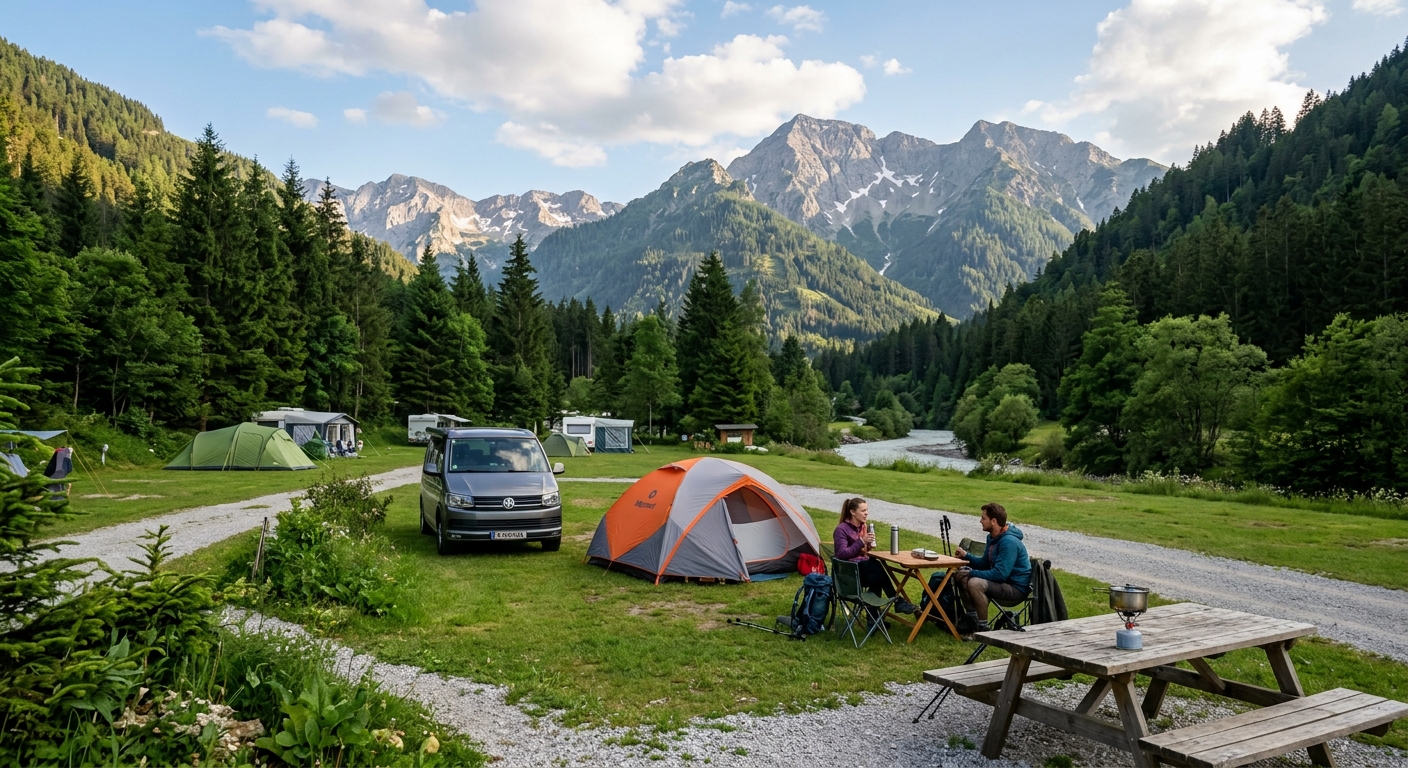
This image was generated with the help of AI.
Camping Site in Lower Austria: how to spot a good one before you arrive
Camping Site in Lower Austria: Why the Search Usually Ends in the Wrong Place
Anyone looking for a camping site in Lower Austria ends up surprisingly often on a gravel patch behind a country pub. Or on a mass site where the pitches are measured so tightly that the awning cannot open fully without knocking on the neighbour’s door.
Friday evening, arrival after 7pm. The barrier is open, nobody else is around. The power comes from a distribution post 40 metres away; your cable reaches 25. Waste water: jerrycan, and you go looking for the drain with a torch. That is not bad luck. That is the predictable outcome when a car park with an electrical box is sold as a pitch.
My view after decades with guests: a camping site in Lower Austria comes down to three things, and they have to come together.
- Services at the pitch itself: electricity, drinking water, waste water disposal, without the jerrycan relay.
- Quiet: not as a marketing word, but as a location.
- An owner you can reach: someone who picks up the phone, including in the evening.
Our site is in Kaumberg, Höfnergraben 2, in a quiet side valley of the southern Vienna Woods. Around 50 pitches, meadows, mixed woodland, a mountain stream, and the farm’s sheep next door. The campsite has been part of the family farm since 1980, and the guiding principle has not changed: “living in nature, with nature.”
That is what this piece is about: how to recognise a good camping site in Lower Austria before you set off. If you would like to approach the search systematically, you will find the criteria in our article on the quiet pitch with full service and disposal facilities.
What full infrastructure at a camping site in Lower Austria actually means
“Full infrastructure” appears on plenty of websites. What it usually means is: an electricity post somewhere along the track, a drinking water tap by the sanitary block, waste water at a central disposal point. In Austria, that is the norm. Electricity, drinking water and waste water disposal on your own pitch are the exception.
Here in Kaumberg, that is exactly the standard. Every pitch has:
- An electricity connection, billed by meter reading at €0.50 per kW. You pay for what you use, not a flat rate that subsidises the neighbour running air conditioning.
- A drinking water connection on the pitch. Water and drainage use are included in the overnight price.
- Waste water disposal via our own site drainage system, right where you are parked.
That sounds technical, but it has a very practical effect on your packing list. No chain of jerrycans, no collection of power banks, no manoeuvring the vehicle over to the disposal point just because the grey water tank is full. We have set out what this means for your luggage in the campervan packing list for summer. Three things matter instead:
- A longer electricity cable, so the post stays within reach even with generous spacing between pitches.
- A water hose with the right fitting, ideally with an adapter for standard threads.
- A waste water hose that genuinely reaches the drainage connection, not the short one that came with the basic kit.
Bring those and you are set up within ten minutes, with nothing left to organise for the rest of your stay.
Pitch size and sanitary facilities: the two things that decide whether a stay works
Anyone who has ever pitched up somewhere the awning almost brushes the neighbour’s vehicle knows how quickly a stay can sour. Our pitches at the camping site in Lower Austria measure around 90 to over 100 square metres. The grounds stretch out lengthways through the side valley, mostly level, with individual trees and hedges in between. Day to day, that means: roll out the awning, set up table and chairs, and there is still space between you and the next pitch. You do not hear their radio and they do not hear your conversation. Why those square metres matter more to us than any star rating is set out in detail in the article on the motorhome pitch in the Vienna Woods.
The second point is the sanitary block. It was rebuilt in 2005 and has accessible facilities. The ratings:
- ADAC: 5 stars for the sanitary building
- ANWB: 8.3 in the Dutch rating
- EU ECO-LABEL, first awarded in 2007
There is Wi-Fi on site, 1 GB fair use free of charge. Enough for the weather forecast, route planning and a few messages.
That leaves the thing travellers complain about most: nobody picks up the phone. Here, Leopold Grandl is your contact for technical and personal questions alike, on +43 676 4741966. Bookings go by email to reservierung@camping-noe.at. If the confirmation does not arrive, please check your spam folder; in our experience, that is where it tends to end up.
Motorhome Pitch in the Vienna Woods as a Base for Vienna
Let us do the maths. A 600 kilometre drive costs you two holiday days in the driver’s seat: one out, one back. Thirty to 35 kilometres costs you half an hour. That is the whole difference between a city break that starts in a fog of tiredness and one that has you sitting on the meadow with a glass of wine by Friday evening.
A camping site in Lower Austria, or more precisely in the Vienna Woods, solves a problem that many city pitches never manage: you spend the day in Vienna and you do not sleep next to an arterial road at night. Schönbrunn Palace, the Hofburg, the museums, a Heuriger wine tavern. Then back to the side valley in Kaumberg, where the neighbours are sheep.
Getting here by car, depending on which direction you come from:
- From the west (A1): exit St. Pölten Süd, take the B20 to Traisen, then at the roundabout onto the B18 towards Hainfeld and on to Kaumberg.
- From Vienna (A21): exit Mayerling, follow the B11 towards Hafnerberg, then the B18 to Altenmarkt.
- From the south (A2): exit Leobersdorf, then via Berndorf onto the B18.
After the turn-off it is another 400 metres or so. Then the traffic is gone.
My view after four decades of welcoming guests: for city visits, the motorhome should stay put. Set up, hook up, leave it where it is. Bus route 169 reaches Matzleinsdorfer Platz in roughly 55 minutes, and from there you continue by underground, suburban rail or tram. Current timetables are on vor.at or postbus.at.
Take the Bus into Vienna Rather Than the Motorhome
Manoeuvring a six metre vehicle through the first district and then hunting for a parking space is the surest way to ruin a day in the city. If you are heading into Vienna from Kaumberg, leave the motorhome on your camping site in Lower Austria and travel by public transport. The interior stays cool, the fridge stays on mains power, and you come back in the evening without having to park a second time. For keeping the vehicle cool on hot days, we have put together 14 tips on cooling your motorhome.
- Bus route 169: direct from Kaumberg to Matzleinsdorfer Platz, journey time around 55 minutes. From there you connect to the underground, suburban rail and tram network, so effectively the whole city.
- Mariazell bus VOR 552: links Wien Mitte directly with Kaumberg, useful for guests arriving without a car.
- Local stops: Kaumberg/Höfnergraben is very close to the site, plus Kaumberg/Marktplatz and Kaumberg/Renzenhof.
One point I want to be clear about: there are only a handful of buses per day, and departure times vary by day of the week. Plan your return journey before you set off. Check current timetables and fares on vor.at, postbus.at or with ÖBB Scotty.
In the city, the time is enough for Schönbrunn, the Hofburg, a museum on the Ring or a Heuriger on the outskirts. And then the ride back to the side valley, where the evenings are quiet.
A stopover en route to Hungary: the shorter way via the B18
Anyone travelling from Germany or the Netherlands towards Lake Balaton tends to stick doggedly to the standard route south of Vienna. That detour costs time. From the site in Kaumberg you take the B18 to Günselsdorf, then head for Eisenstadt and on across the border. Compared with the usual route, that is around 30 kilometres less.
The second point weighs more than the kilometres: what does a night at a motorway rest area actually give you? Lorry refrigeration units, no electricity, full waste water tanks and, in the morning, the question of where to empty them legally. A stopover at a camping site in Lower Austria with full infrastructure sorts all of that in one go:
- waste water disposed of directly at your pitch via the site’s own drainage system
- fresh water topped up at the pitch
- electricity at the pitch, so batteries and the leisure battery charge overnight
- showers in the sanitary building, awarded 5 stars by the ADAC
- drive on well rested, rather than being woken at six by the next engine starting up
Why a single night on the road often counts for more than the destination is something we cover in our piece on short-stay pitches for motorhomes. For exactly this case there is a reduced one-night rate: 2 people plus motorhome, 26.00 euros. Electricity is billed by meter reading, 0.50 euros per kW. Tourist tax, refuse charge, water and drainage are included.
Two things to note in advance: payment is cash only, we do not accept cards. And the current list of all rates is at camping-noe.at/preise/.
What sets this place apart from a plain pitch: farmyard, fruit trees, Wienerwald
A parking bay for motorhomes goes up quickly: gravel, electricity, barrier. This place grew differently. The camping ground belongs to a working sheep farm; the homestead is first mentioned in the house chronicle in 1380 and has been in family hands for around 200 years. The sheep graze on the meadows a short walk from the pitches. Roughly 120 old fruit varieties stand on the grounds, about 70 of them grafted and planted by Leopold Grandl himself.
Then there is the setting: a quiet side valley on the bank of a mountain stream, meadows and mixed woodland, wooded ridges behind. The Wienerwald Biosphere Reserve begins to the north, and it is a Natura 2000 site at the same time. Protected species and habitats here include:
- calcareous dry grassland with brome and fescue
- beech woods whose stands are considered rare in Europe
- the marsh fritillary butterfly
- the lesser mouse-eared bat
My view on this is clear: these surroundings are precisely why a camping site in Lower Austria should not be packed tighter and tighter. Squeeze extra rows in between old fruit trees and you end up selling off the very view your guests came for. So it stays at around 50 pitches of 90 to over 100 square metres, and no more.
Practical details: dogs are welcome. There is an inn on site serving home cooking from its own kitchen. The 2026 season runs from 30 March to 30 September.
A full day out without starting the engine
Anyone staying at this camping site in Lower Austria can fill a whole day without moving the vehicle. Kaumberg has 52 kilometres of waymarked walking trails, and they start practically at the gate. To my mind that is the real value of a pitch in a side valley: the day begins on foot, not with a hunt for a parking space.
- Araburg castle ruins: at 800 metres, the highest castle ruins in Lower Austria. Follow the green waymarks from the centre of Kaumberg; about 1.5 hours on foot across meadows and through mixed woodland.
- Via Sacra: Austria’s oldest pilgrim route to Mariazell passes directly by the site. Pilgrims have use of a shower, charging for their phone and free Wi-Fi. By arrangement, the car can stay in the farm car park until the return journey.
- Triestingtal-Gölsental cycle path: 62 kilometres along the riverbanks, linking to the Thermen cycle path and the Traisental cycle path. Stages are easy to cut to fit your fitness.
If you do want to drive, plenty lies within easy reach: Heiligenkreuz Abbey, the pilgrimage church of Klein-Mariazell, the spa town of Baden, the wine village of Gumpoldskirchen, Schneeberg and Rax with their rack railway and cable car, plus the Weisser Zoo in Kernhof with the only white tigers in Austria.
One tip that saves frustration: check opening hours, operating days and prices in advance on the official websites of each attraction. Seasonal changes are the rule here, not the exception.
Long-Term Camping at a Camping Site in Lower Austria: when a pitch becomes a second home
At some point the searching itself turns into work. Friday afternoon, phone calls, availability checks, another new site, another set of washrooms of unknown quality. Anyone who wants to leave that behind starts thinking about long-term camping at a Camping Site in Lower Austria. With us in Kaumberg, that is possible: a quiet spot in a side valley of the southern Vienna Woods, pitches with electricity, drinking water and waste water disposal via our own drainage system, around 30 kilometres from Vienna. Close enough for an evening at the opera, far enough that you wake up to sheep rather than traffic.
Terms, available plots and contract details are best discussed directly. Blanket figures help nobody here, because every situation looks different. Leopold Grandl, +43 676 4741966, reservierung@camping-noe.at. If you are also considering a mobile home, you will find information at mobilheim.me.
And since the question comes up anyway: how do you recognise a good Camping Site in Lower Austria before you book? By six plain points. If this is your first trip in a van, there are further pointers in our vanlife beginner tips for Austria.
- Pitch size in square metres. Not “generous”, but a number. With us, roughly 90 to over 100 m².
- Connections on the pitch itself. Electricity, drinking water, waste water. Not somewhere across the grounds.
- Year of construction and condition of the washrooms. Our building dates from 2005 and was awarded five stars by the ADAC.
- Season dates. In 2026 we are open from 30 March to 30 September.
- Payment method. With us it is cash only, which is worth knowing in advance.
- Does anyone answer the phone? The simplest test, and the most telling one.
Frequently Asked Questions
What makes a good Camping Site in Lower Austria?
What counts is the kit on the pitch itself: electricity, drinking water and waste water disposal right where you park, rather than lugging canisters back and forth. Then there is size. Our pitches in Kaumberg run from around 90 to over 100 m², enough for the caravan plus awning without your neighbour looking in through the window. And a well-kept sanitary building: ours was rebuilt in 2005 and awarded 5 stars for sanitary facilities by the ADAC.
Does a Camping Site in Lower Austria work as a base for visiting Vienna?
Yes, provided the distance is right. Camping Paradise Garden sits roughly 30 to 35 km south-west of Vienna in the southern Vienna Woods. Bus route 169 runs directly to Matzleinsdorfer Platz in about 55 minutes, and from there you continue by underground, suburban rail or tram. Current departure times and fares are on vor.at, postbus.at or in ÖBB Scotty.
What does a night at a Camping Site in Lower Austria cost?
With us, 1 caravan or motorhome with 2 people costs EUR 33.00 per night, with 1 person EUR 19.00. Visitor’s tax, refuse charge, water and drainage use and VAT are all included; electricity is billed at EUR 0.50 per kW according to the meter reading. Payment is in cash only, card payment is not possible. The full price list is at camping-noe.at/preise/.
When is the Camping Site in Lower Austria open, and how do I book?
The 2026 season runs from 30 March to 30 September. We take reservations all year round by email at reservierung@camping-noe.at, or by phone on +43 676 4741966. If no confirmation arrives within a short time, it is worth checking your spam folder.
Is the site a sensible stopover on the way to Hungary?
The site lies on the shortest route east and saves around 30 km compared with the standard route. From the campsite you take the B18 to Günselsdorf, then head towards Eisenstadt and on into Hungary. Reduced rates apply for one or two nights, for example EUR 26.00 for 2 people with a caravan or motorhome.
How do I reach the owner if something comes up on site?
Leopold Grandl can be reached personally on +43 676 4741966, for technical as well as practical questions. The campsite is part of the family’s own sheep farm, so the owner is on site rather than at some head office. That is the difference from places where nobody answers the phone after dark.